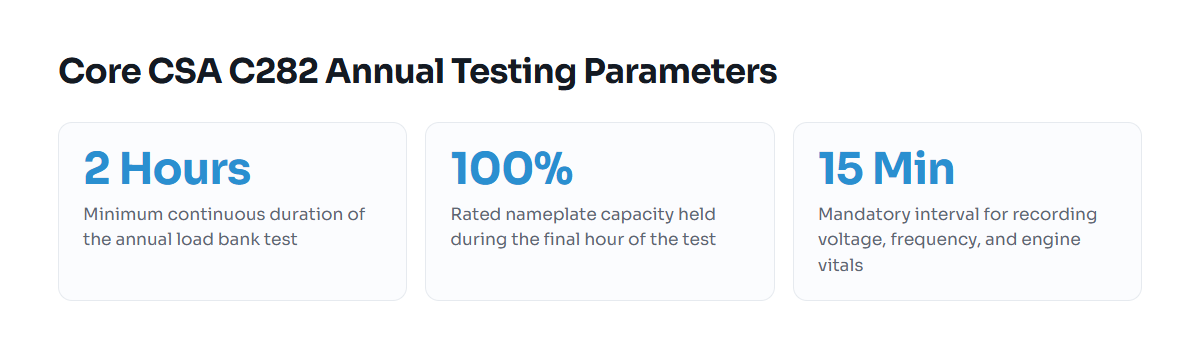
CSA C282 annual testing requires a full load-bank test of the emergency generator for at least two consecutive hours, laboratory sampling of diesel fuel, and operational verification of all transfer switches and auxiliary subsystems. In Alberta, building owners must perform these inspections annually under the National Building Code (Alberta Edition) and local fire prevention bylaws to ensure life-safety power remains operational during a utility outage.
The Purpose and Schedule of CSA C282 Annual Verification
CSA C282 defines the design, installation, maintenance, and testing requirements for emergency electrical power supply systems in buildings. Where an emergency generator feeds life-safety loads such as exit signs, fire pumps, emergency lighting, and smoke control systems, the standard enforces a scheduled maintenance regime. Building codes across Canada, including the National Building Code (Alberta Edition) 2023, mandate compliance with CSA C282 for emergency equipment.
Emergency generators frequently sit idle or run only during short, unloaded monthly exercise cycles. These light-load conditions allow unburned fuel and carbon deposits to accumulate in the exhaust system, a condition known as wet stacking. Light running also fails to confirm that the cooling system can dissipate heat under maximum design demand or that the voltage regulator stabilizes under full load. The annual inspection serves as a proof test. It confirms that the engine, alternator, mechanical ventilation louvres, day tank pumps, and control systems operate properly under real emergency conditions. To understand the design baseline that feeds into this testing, review our guide to Emergency Generator Requirements for Buildings.
Governing Codes and Mandatory Annual Test Tasks
In Alberta, the requirement to install and maintain an emergency power supply stems from NBC(AE) 2023, which directs practitioners to CSA C282. Electrical installations follow CEC 2024 Section 46, which outlines wiring methods and transfer arrangements for emergency systems. Routine operation, inspection, and maintenance must strictly follow the tables in CSA C282.
The annual testing regime contains several mandatory technical milestones that exceed regular weekly or monthly visual checks:
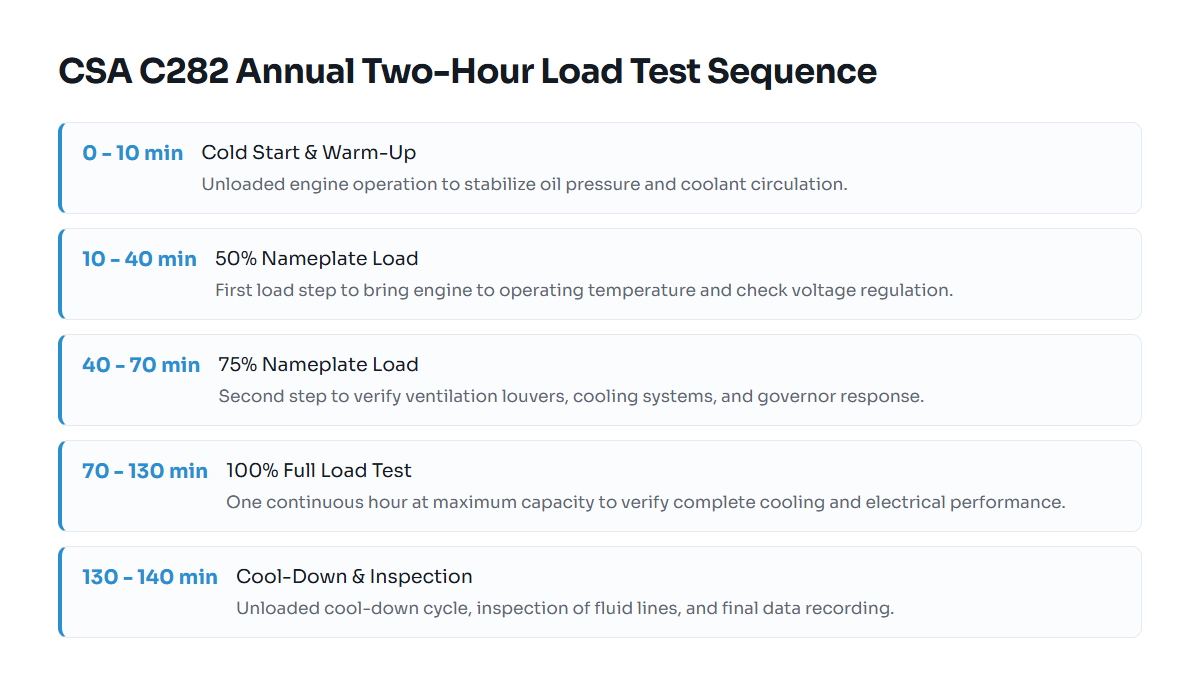
- Two-Hour Load Bank Test: The generator must run under artificial electrical load using a portable resistive load bank or a building load. CSA C282 prescribes operating the generator set for two continuous hours: typically initiated at building load or partial load, followed by operating at not less than full rated capacity (100% of the nameplate kilowatt rating) for the second hour. Engine coolant temperature, oil pressure, exhaust temperature, output voltage, and frequency must be logged every 15 minutes.
- Fuel Quality Testing: Diesel fuel degrades over time through oxidation, condensation, biological growth, and particulate accumulation. A certified laboratory must test a bottom-taken fuel sample for water content, sediment, and microbial growth in accordance with ASTM standards referenced by CSA C282.
- Automatic Transfer Switch (ATS) Verification: Technicians must simulate a primary utility power failure to verify that the ATS senses the outage, initiates an engine start, transfers the emergency panelboard loads within the required time, and retransfers smoothly once utility power stabilizes. Mechanical interlocks, bypass switches, and contact wear must be physically inspected.
- Subsystem Functional Testing: Verification must include the battery charger float and equalization voltages, remote annunciator alarms, block heater operation, automatic fuel transfer pumps, and motorized room ventilation dampers. Dampers must open automatically upon an engine crank signal.
- Integration with Fire Alarm Systems: When a building conducts its annual fire alarm testing under CAN/ULC standards, technicians must verify that the fire alarm control unit correctly receives supervisory signals from the generator system, including generator running, generator trouble, and transfer switch status.
Load Testing Parameters: 200 kW Diesel Generator Example
To understand the electrical and mechanical load conditions encountered during annual compliance, consider a typical commercial building with a 200 kW, 250 kVA, 600/347 V, 3-phase diesel generator.
1. Full-Load Current Calculation
To select cables and load-bank steps, calculate the rated output current across the three phases:
Rated Line Current = Nameplate kVA / (1.732 × Line Voltage) = 250,000 VA / (1.732 × 600 V) = 240.6 A per phase.
The portable load bank must pull 241 A continuously at 600 V to test the engine and alternator at 100% rated capacity.
2. Step-Load Schedule
Technicians install the load bank outside the electrical room or park it on a mobile trailer, routing temporary cables to the emergency bus via dedicated cam-lock connectors or a load-bank breaker. The two-hour test follows this stepped sequence:
| Test Segment | Duration | Applied Load | Amps per Phase (600 V) | Primary Verification Targets |
|---|---|---|---|---|
| Warm-Up | 10 minutes | 0 kW (Unloaded) | 0 A | Oil pressure buildup, coolant circulation, no fuel leaks. |
| Step 1 | 30 minutes | 50% (100 kW) | 120.3 A | Thermostat opening, exhaust temperature rise, voltage stability. |
| Step 2 | 30 minutes | 75% (150 kW) | 180.4 A | Motorized intake/exhaust dampers fully open, fan operation. |
| Step 3 (Peak) | 60 minutes | 100% (200 kW) | 240.6 A | Maximum cooling capacity, oil temperature plateau, frequency drop under 2%. |
| Cool-Down | 10 minutes | 0 kW (Unloaded) | 0 A | Turbocharger cool-down, shutdown timer function. |
3. Fuel Consumption During Test
A modern 200 kW tier-compliant diesel generator consumes roughly 55 to 60 litres of fuel per hour at full load. During a complete test setup—including pre-checks, stepped loading, full capacity running, and cool-down—the unit will consume approximately 100 to 120 litres of diesel. Facility managers must confirm the main storage tank has sufficient reserve to complete the test while retaining the code-required run time (typically 2 hours for life safety, up to 72 hours for high-hazard or health care occupancies) for actual emergencies.
Common Points of Failure in Alberta Installations
Annual inspections frequently uncover preventable equipment and procedural faults. Addressing these items before the annual test contractor arrives avoids re-testing expenses and municipal inspection notices:
- Cold-Weather Louver Freeze-Up: In Alberta winters where ambient temperatures drop below -30°C, outdoor exhaust and intake dampers often freeze shut. If the motorized damper actuator fails or the blades ice over, the generator engine starves for combustion air or overheats within five minutes under load. Louver end switches must be tested to ensure the engine will not run if intake dampers remain closed.
- Starting Battery Degradation: Lead-acid starting batteries are the single most common cause of generator failure. CSA C282 requires conductance testing or specific gravity checks. Batteries over three years old often show high internal resistance, causing cranking voltage to dip below the threshold required to hold digital engine controllers active.
- Unsampled or Contaminated Diesel: Fuel tanks with low turnover accumulate condensation through seasonal temperature swings. Water promotes microbial colonies (fungal growth) that plug fuel filters within the first 20 minutes of continuous full-load operation, stalling the engine long before the two-hour test concludes.
- Omitted Transfer Switch Servicing: Contractors often bring a load bank, connect directly to the generator terminals, and never exercise the ATS under load. This fails to satisfy CSA C282. The automatic transfer switch contacts, control wiring, and mechanical latches must be verified under genuine transfer conditions.
- Uncoordinated Upstream Protection: If temporary load-bank feeder conductors are not properly sized or protected, ground fault or overcurrent devices may trip unexpectedly during the 100% capacity step, forcing an abrupt engine unload.
Annual Inspection and Verification Checklist
The facility maintenance team or testing contractor should record the following checkpoints in the permanent on-site log book mandated by CSA C282:
- Pre-Test Fluid Checks: Inspect engine oil level, coolant level and glycol freeze point (-40°C minimum for Alberta), primary and secondary fuel filter differentials, and battery electrolyte levels.
- Fuel System Integrity: Draw a fuel sample from the bottom drain of the main storage tank and submit it to a certified fuel analysis laboratory. Inspect all flexible fuel lines for cracking, leaks, or heat degradation.
- Electrical Connections: Check torque on generator output busbars, neutral connections, and ATS terminals using calibrated torque tools or thermal imaging.
- Emergency Stop Verification: Test all remote emergency stop break-glass stations to confirm positive shutdown of the fuel solenoid and air intake shutoff valves.
- Exhaust System Inspection: Verify flex bellows, silencer insulation blankets, condensation drains, and exterior flapper caps for mechanical freedom and signs of exhaust gas leakage inside the building envelope.
- Ventilation and Heating Systems: Measure engine room ambient temperature with the generator stopped to confirm space heating maintains at least 10°C. Test damper actuators and auxiliary fan interlocks.
- Load Bank Verification: Complete the continuous two-hour load cycle, logging engine oil pressure, coolant temperature, DC charging voltage, AC output voltage, frequency, and current across all phases at 15-minute intervals.
- Log Book Endorsement: Ensure the qualified testing technician signs and dates the CSA C282 maintenance log, documenting all meter readings, fluid test reports, and any corrective work needed. Maintain this log on-site for review by the local Fire Prevention Bureau and electrical safety officers.
For facility managers preparing for building alterations, service upgrades, or emergency power retrofits, engaging qualified electrical engineering services in Alberta ensures your standby systems comply with all municipal safety bylaws and technical standards.
Free tools: kVA to amps calculator