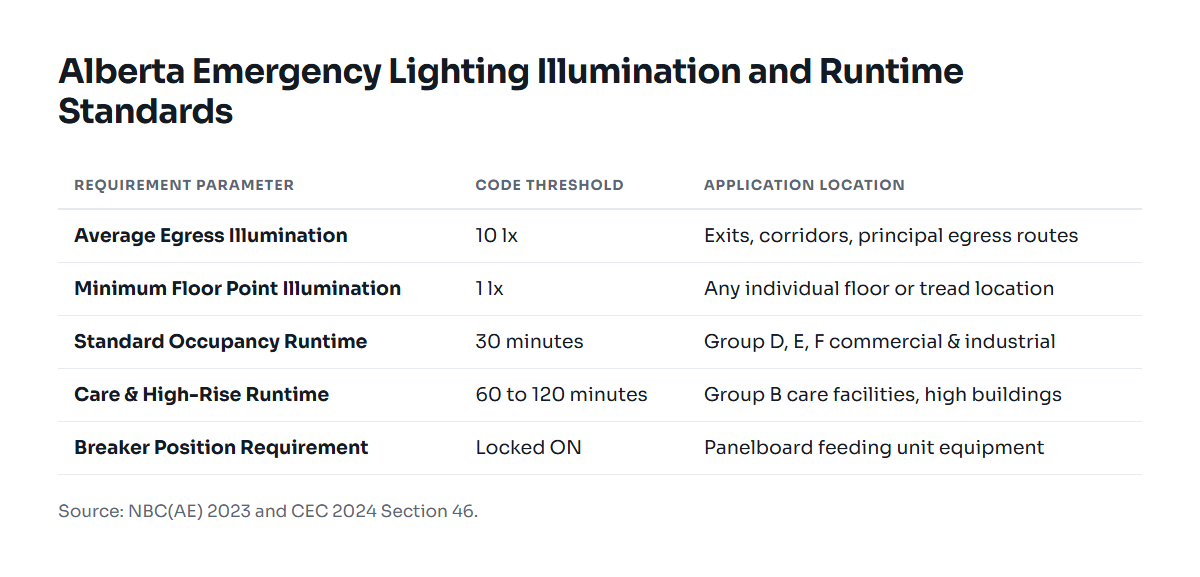
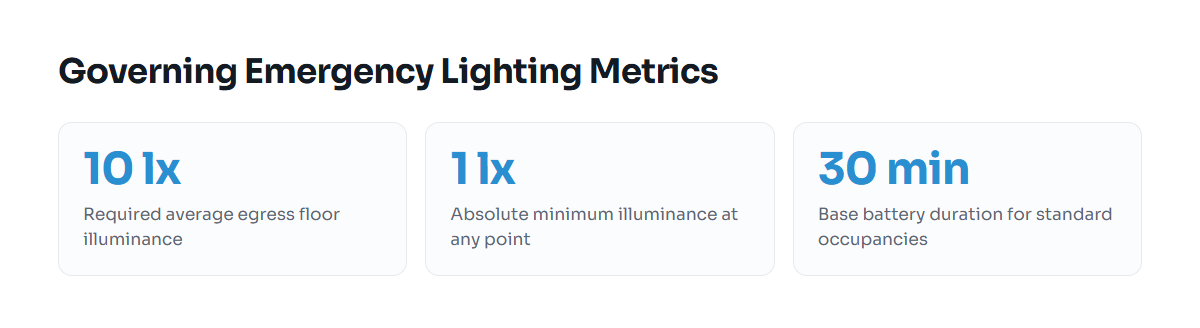
Emergency lighting requirements in Alberta mandate an average minimum illumination of 10 lx along the path of egress, floor areas, and designated exit paths, with no point falling below 1 lx. Power must activate automatically within seconds of normal power failure and operate for a minimum duration of 30 minutes, extending to 60 or 120 minutes depending on building classification, occupancy, and building height under the National Building Code (Alberta Edition).
The Core Mandates for Alberta Buildings
In Alberta, the installation of emergency lighting is governed by two interlocking codes: the National Building Code – 2023 Alberta Edition (NBC(AE)) and the Canadian Electrical Code (CEC 2024, CSA C22.1-24). The building code establishes where emergency lighting is required, what illumination levels must be maintained, and how long the backup source must run. The electrical code governs circuit wiring, disconnect provisions, power supply connections, and equipment construction.
Emergency lighting provides illumination for safe evacuation when normal building power fails. It is distinct from exit signage, though unit equipment often feeds both. The core baseline criteria under NBC(AE) 2023 include:
- Minimum Illumination: An average of 10 lx at floor or tread level throughout exits, public corridors, corridors serving the public, and principal access-to-exit routes. The absolute minimum at any individual point cannot drop below 1 lx.
- Service Rooms: At least 10 lx must be supplied in electrical service rooms, emergency generator rooms, and designated fire alarm control locations so service personnel can operate life safety gear during a utility blackout.
- Activation Speed: The emergency power source must deliver rated illumination automatically upon interruption of normal electrical supply.
- Minimum Duration: A baseline run time of 30 minutes for standard Part 3 commercial, retail, industrial, and medium-hazard industrial occupancies. High buildings, care occupancies, and hospitals carry longer duration baselines, often requiring 60 to 120 minutes or a permanent generator installation.
Code Framework: NBC(AE) 2023 and CEC 2024
Emergency lighting must be treated as an essential life safety subsystem. The engineering requirements are divided between spatial mandates in the building code and wiring mandates in the electrical code.
Illumination Levels and Uniformity
Designers measure illumination in lux (lumens per square metre). Normal commercial office illumination typically sits between 300 lx and 500 lx. The emergency standard of an average of 10 lx ensures individuals can identify stairs, obstacles, changes in direction, and exit doors without disorientation. A high contrast ratio creates black spots where hazards remain unseen, which is why the code sets the strict 1 lx minimum floor threshold alongside the 10 lx average.
Power Supply Duration by Building Classification
The required backup duration depends on the building use, occupant vulnerability, and evacuation time. The table below outlines how building types dictate emergency run times and typical backup equipment configurations.
| Occupancy / Classification | Minimum Duration | Typical Power Source | Governing Considerations |
|---|---|---|---|
| Standard Commercial / Industrial (Group D, E, F) | 30 minutes | Self-contained battery unit equipment (pack and heads) | Standard office, retail strip, small warehouse |
| High-rise Buildings (Group D or Group C under Section 3.2.6) | 120 minutes | Life safety emergency generator (CSA C282) | Extended evacuation and fire response times |
| Care Occupancies & Residential Care (Group B, Division 2 / 3) | 60 to 120 minutes | Central battery system or generator | Non-ambulatory or vulnerable occupants |
| Assembly Occupancies (Group A, e.g., theatres, arenas) | 30 to 60 minutes | Unit equipment or emergency generator | High-density crowds with complex egress routes |
Circuitry and Disconnecting Means Under CEC Section 46
CEC 2024 Section 46 details the wiring methods for emergency systems. It explicitly prohibits running emergency lighting circuits on common utility branches that could be shut off accidentally. Key wiring mandates include:
- Power Source Connection: Emergency lighting unit equipment must be connected to an AC circuit supplied from the same panelboard that feeds the normal lighting in the area served.
- Locking Breakers: The branch circuit breaker feeding unit equipment must be clearly identified and locked in the ON position to prevent accidental de-energization by maintenance staff.
- Sensing Points: If a local branch circuit feeding normal lighting fails, the emergency lighting for that space must turn on. Connecting unit equipment to a distant electrical room circuit without local area sensing violates the code's intent, because a local trip leaves the room dark while the emergency pack fails to sense a power loss.
For buildings that rely on a stationary standby power system instead of isolated battery units, the electrical distribution must satisfy emergency generator requirements for life safety under Section 46 and the National Standard of Canada CSA C282.
Application on a Real Project: A Step-by-Step Design Example
Consider an actual project example: a two-storey commercial office building in Red Deer, Alberta, with 1,200 m² floor plates. The design involves specifying emergency lighting for a main exit corridor that measures 30 m long and 2.4 m wide (72 m² total area).
Step 1: Determine the Egress Illumination Baseline
Under NBC(AE) 2023, the corridor requires an average of 10 lx across the entire 72 m² floor surface, with no point falling below 1 lx. The total required lumens delivered to the workplane can be estimated with the lumen formula:
Total Effective Lumens = Area (m²) × Required Average Illuminance (lx) = 72 m² × 10 lx = 720 net lumens.
Because optical losses, fixture spacing, and wall absorption reduce efficiency, a fixture utilization factor and maintenance factor must be applied. Assuming an overall luminaire coefficient of 0.50, the required raw lamp output is 1,440 lumens distributed evenly along the corridor length.
Step 2: Select Equipment and Layout
Rather than placing a single large head that blazes high lux at one spot while leaving the corridor ends below 1 lx, the engineer specifies three dual-head LED remote fixtures spaced 10 m apart. Each head provides 250 lumens (500 lumens per location, totaling 1,500 lumens). Photometric modeling verifies that the centre of each beam provides roughly 12 to 14 lx, overlapping to maintain at least 2.5 lx at the furthest edge, which easily clears the 1 lx minimum code threshold.
Step 3: Size the Battery Pack
The three remote dual-head fixtures run on low-voltage DC (typically 12 V or 24 V) connected back to a central battery pack mounted in a nearby utility closet. The exit signs along this route also connect to this pack:
- Six emergency heads @ 5 W each = 30 W
- Two running-man exit signs @ 3 W each = 6 W
- Total connected emergency load = 36 W at 12 V DC
The building classification requires a 30-minute run time. A standard commercial battery pack rating is stated in watts delivered over a specific duration (e.g., 36 W for 30 minutes, 72 W for 30 minutes, or 100 W for 120 minutes). For this space, an engineer specifies a standard 12 V pack rated for a minimum of 72 W for 30 minutes. This provides a 50% safety margin for future degradation and cold-temperature cell performance.
Step 4: Check DC Voltage Drop
Low-voltage DC wiring is particularly vulnerable to voltage drop. Running 36 W at 12 V means drawing 3 A. If the furthest head is 25 m away, the round-trip distance is 50 m. Using undersized #14 AWG wire can induce a voltage drop exceeding 5%, which significantly dims the LED heads below their rated lumen output. Designers use a voltage drop calculator or standard resistance tables to ensure the voltage drop does not drop fixture terminal voltage below acceptable thresholds, stepping up to #10 AWG or #12 AWG conductors when required.
Common Misconceptions
Working through commercial permits in Edmonton, Calgary, and rural Alberta reveals recurring mistakes made by contractors and building managers regarding emergency lighting systems.
Misconception 1: "Exit signs provide adequate emergency lighting"
Illuminated exit signs indicate the location of an egress door, but their luminous flux is directed through the sign face for readability, not onto the walking surface. They rarely emit the light distribution needed to achieve 10 lx on the floor. Dedicated emergency heads or integrated emergency ballast fixtures are required.
Misconception 2: "Plugging battery units into any wall outlet is acceptable"
Plugging an emergency unit into a general convenience receptacle where a cleaner can pull the plug violates CEC 2024 Section 46. Unit equipment must be hardwired or plugged into a dedicated receptacle that is physically secured or locked, mounted out of reach, and fed from the local lighting panelboard circuit with a breaker lockout device.
Misconception 3: "Emergency lighting is maintenance-free until the power goes out"
Lead-acid and nickel-cadmium batteries degrade. Sealed units regularly fail after four to six years. The National Fire Code (Alberta Edition) and CSA standards dictate functional monthly tests (push-button for 30 seconds) and an annual full-duration discharge test under simulated primary failure conditions. For facilities backed by engine-driven systems, routine verification must follow our CSA C282 annual testing guide.
Related Life Safety and Coordination Requirements
Emergency lighting interacts directly with architectural egress design, building fire alarms, and auxiliary generators.
Fire Alarm and Relay Integration
In modern commercial interiors, ambient lighting is controlled through digital dimmers, scene controllers, or occupancy sensors. If a power outage occurs, or if a building goes into fire alarm, emergency lighting fixtures that serve double-duty as normal architectural lights must bypass local dimmer stations. An emergency lighting control device (ELCD) listed under CAN/ULC or CSA standards is wired to sense normal power loss or fire alarm activation and instantly force the fixture to 100% full brightness.
Standby Power Generation Systems
Large multi-storey commercial towers and care facilities cannot rely solely on wall-mounted battery units due to maintenance complexity. These buildings deploy stationary diesel or natural gas generators. Life safety generator systems are governed by CSA C282 and must separate life safety loads (emergency lighting, exit signs, fire pumps, and smoke control fans) onto dedicated automatic transfer switches (ATS) distinct from optional standby building power. The transfer switch must change over and stabilize the emergency lighting circuits within 10 to 15 seconds of utility failure.
For complex installations or code-compliance reviews across Alberta, consult with registered professionals providing electrical engineering services in Alberta to ensure your electrical permits, safety codes audits, and egress lighting plans pass inspection without delays.
Free tools: kVA to amps calculator