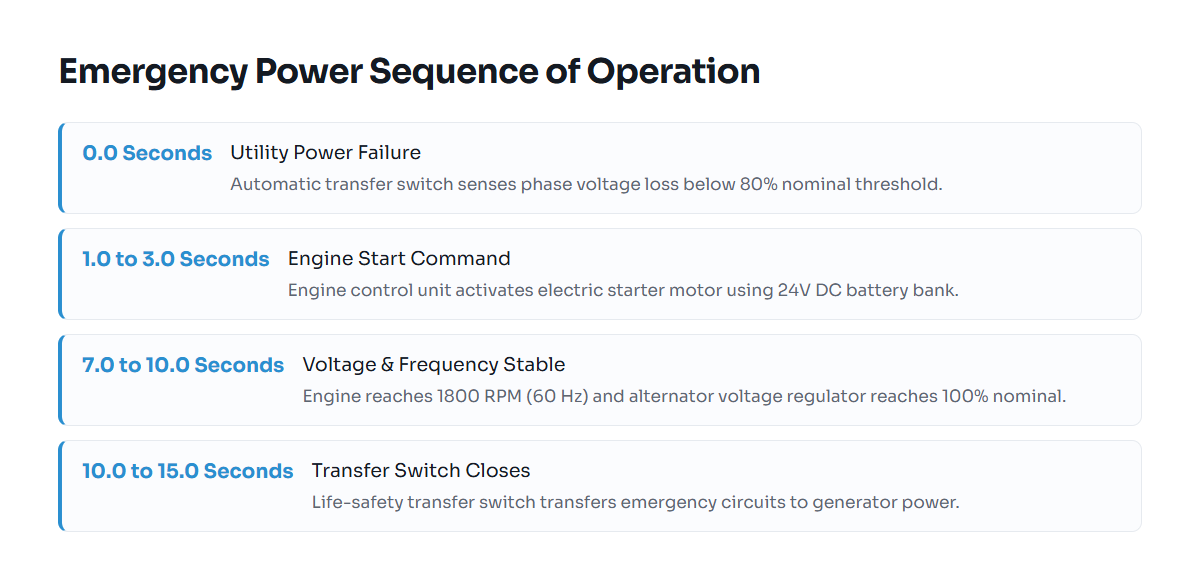
An emergency power system is an independent backup electrical source designed to automatically supply electricity to critical life-safety and legally required building loads when the primary utility grid fails. It consists of a power source such as a diesel or natural gas generator set, an automatic transfer switch, distribution wiring, and connected equipment including fire pumps, egress illumination, smoke evacuation fans, and fire alarm systems. Under Canadian building codes, an emergency power system must supply power to life-safety loads within 15 seconds of utility loss.
Understanding Emergency Power Systems Under Canadian Standards
In Alberta building projects, the term emergency power system refers to an electrical supply specifically dedicated to protecting human life and municipal firefighting operations during a blackout or disaster. The overarching design structure depends on two main regulatory documents: the National Building Code (Alberta Edition), abbreviated as NBC(AE) 2023, and the Canadian Electrical Code (CEC) Part I, known as CSA C22.1-24. When an engineer specifies an emergency generator for a commercial tower, care facility, or industrial site, standard CSA C282 governs the installation, fuel storage, and physical separation of the generation plant.
Building owners often conflate emergency power with standby power, optional backup power, or continuous cogeneration. An emergency power system carries a legally mandated status under the building code. A failure in an emergency system directly threatens human life during an evacuation. In contrast, optional standby systems exist solely to avoid economic losses, preserving computer servers, refrigerated stock, or mechanical chillers. Standby generators or co-generation units can supplement a facility, but they cannot compromise the isolation, transfer timing, or fuel autonomy required for emergency life-safety equipment.
A compliant installation coordinates the generator set, control panel, battery chargers, exhaust systems, fuel piping, and distribution feeders. When evaluating electrical engineering services in Alberta, teams look for proper segregation of circuits. The Canadian Electrical Code requires emergency branch circuits to run in separate raceways, boxes, and conduits from normal building electrical distribution to prevent a fault on non-critical equipment from blinding the life-safety system.
Governing Codes for Backup and Life-Safety Power
The requirement for an emergency power system originates in the building code, not in the electrical code. NBC(AE) 2023 sets which buildings require emergency power based on building height, occupant load, major occupancy classification, and fire protection measures. Once NBC(AE) mandates emergency supply, CSA C282 and the CEC define how the electrical and fuel systems must be designed, connected, and operated.
National Building Code (Alberta Edition) Mandates
NBC(AE) 2023 specifies the exact systems that must maintain electrical supply upon normal power failure. These include:
- Emergency lighting for exit paths, corridors, and service rooms.
- Exit signs indicating egress routes.
- Building fire alarm systems and voice communication systems.
- Fire pumps and water-pressure booster systems dedicated to fire protection.
- Elevators designated for firefighter use in high-rise buildings.
- Mechanical smoke-venting fans, stair pressurization fans, and damper actuators.
NBC(AE) 2023 dictates the minimum duration an emergency power source must run without refueling. For example, hospitals, high-rise residential towers, and care facilities often require full emergency operations for two hours, while other occupancies may require longer runtimes depending on fuel type, location, and seismic criteria.
Canadian Electrical Code (CEC 2024) Requirements
CEC 2024 enforces clear segregation between emergency equipment and conventional commercial power. Emergency circuits must terminate inside dedicated panels and must not share pull boxes or conduits with utility circuits. Transfer switches must be listed for emergency service and must monitor all ungrounded phases of the normal utility service. When the utility voltage drops below normal operating thresholds, the transfer switch signals the generator set to start, reaches operating frequency and voltage, and transfers the load within 15 seconds.
CSA C282 Emergency Electrical Power Supply for Buildings
The standard governing generator selection, fuel delivery, and environment is CSA C282. This standard categorizes systems based on fuel storage capacity and transfer times. It requires the generator set to be enclosed in a dedicated service room separated from the rest of the building by a fire-resistance rating. It also regulates fuel supply autonomy, air intake dampers, exhaust piping, remote annunciators, and maintenance protocols.
| System Attribute | Life Safety (Emergency System) | Optional Standby System |
|---|---|---|
| Code Authority | NBC(AE) 2023 / CSA C282 / CEC 2024 | Owner Discretion / CEC 2024 Section 46 |
| Transfer Time | Maximum 15 seconds for critical loads | No code limit (typically 60+ seconds) |
| Circuit Segregation | Dedicated conduits, raceways, and panels | Can share distribution equipment |
| Fuel Storage | Minimum 2 hours on-site runtime mandated | Owner choice; natural gas common |
| Annual Testing | Mandatory logging per CSA C282 | Voluntary maintenance schedule |
How an Emergency Power System Applies to a Real Project
Designing an emergency power system involves selecting the fuel source, sizing the generator alternator and engine, isolating critical distribution, and coordinating automatic transfer operations. In Alberta, temperature extremes impose severe physical constraints on cold starting, fuel selection, and ventilation design.
Worked Example: High-Rise Residential Building Sizing
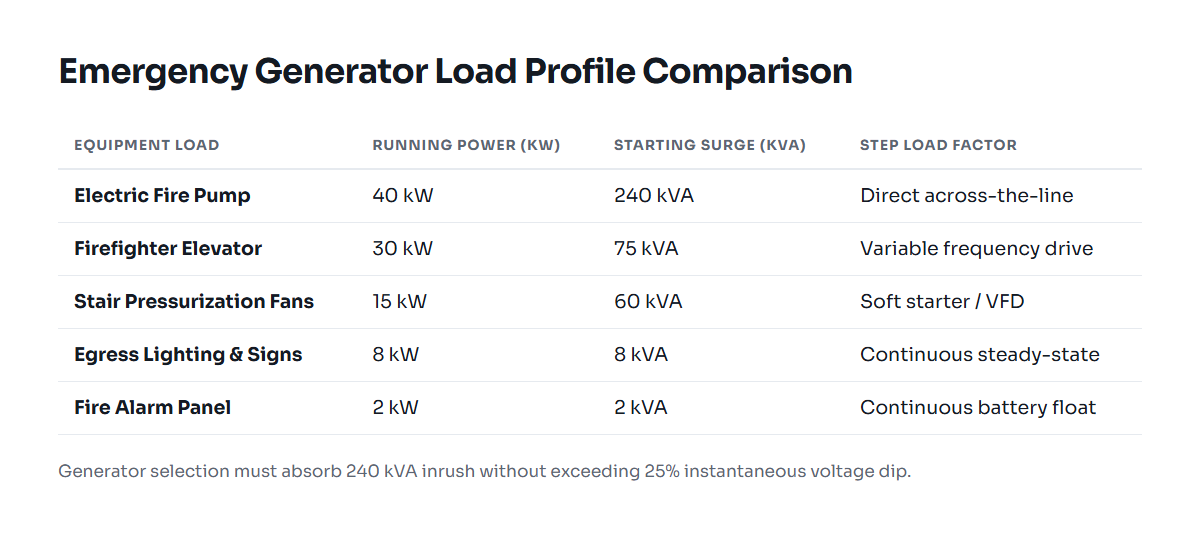
Consider a 12-storey residential building in Calgary requiring emergency power for life-safety compliance under NBC(AE) 2023. The engineering team conducts a load assessment to establish both the running kilowatt (kW) draw and the starting kilovolt-ampere (kVA) inrush current.
The connected life-safety loads are:
- Fire pump (electric motor): 40 kW running (240 kVA starting inrush with across-the-line start).
- Firefighter elevator: 30 kW running (75 kVA starting with a variable frequency drive).
- Emergency egress lighting and exit signs: 8 kW continuous (8 kVA).
- Fire alarm panel and booster supplies: 2 kW continuous (2 kVA).
- Stair pressurization fans (two fans): 15 kW running (60 kVA starting).
Total steady-state running load equals 95 kW. At a standard 0.8 power factor, this equates to 118.75 kVA. However, generator sizing cannot be based purely on running load. An internal combustion engine coupled to an alternator experiences momentary voltage dips and frequency drops when large motors start.
To evaluate phase current and calculate feeder requirements for this building, designers use tools like the kVA to Amps Calculator. If the 40 kW fire pump starts across the line while the elevator and fans are operating, the generator alternator must supply the combined 95 kW running load plus the fire pump's 240 kVA starting surge without letting generator terminal voltage drop more than 20 to 25 percent. A voltage drop greater than 20 percent will cause motor starters to drop out and fire alarm system power supplies to reset.
Applying standard alternator transient reactance values, an engineer specifies a minimum 200 kW / 250 kVA diesel generator set. This unit accommodates the motor starting step loads while leaving sufficient operating margin. To learn more about life-safety sizing and stepped load sequences, refer to Emergency Generator Requirements: Life Safety & Sizing.
The Alberta Environment: Cold Starting and Permitting
In Alberta, outdoor winter design temperatures frequently plunge below minus thirty degrees Celsius. Generators installed outdoors in weatherproof enclosures or in unheated mechanical penthouses require block heaters, oil pan heaters, and heavy-duty battery warmers. Under CSA C282, an emergency generator must start and assume full rated life-safety load within 15 seconds. If the coolant temperature drops below acceptable limits, the engine will crank sluggishly, miss ignition, and fail the 15-second transfer requirement.
For projects in the City of Calgary or the City of Edmonton, emergency power installations demand coordination across multiple authorities. The project requires:
- An electrical permit from the local municipality, submitted with single-line diagrams showing transfer switches, overcurrent protection, and conductor separation.
- A mechanical permit for generator room combustion air intake dampers, exhaust ducting, and ventilation.
- A fuel storage permit from the Alberta Boilers Safety Association (ABSA) or the local fire department for on-site diesel fuel storage tanks.
- Review by the local electric utility (ENMAX, EPCOR, ATCO, or FortisAlberta) to confirm transfer switch interlocking. The utility mandates open-transition or certified closed-transition switches to prevent unsynchronized backfeeding into the utility grid.
Common Misconceptions in Backup Power Design
Confusion between municipal codes, equipment specifications, and utility requirements often leads to design mistakes that delay occupancy permits.
Misconception 1: Utility Natural Gas Counts as Guaranteed Emergency Fuel
Many owners ask for natural gas generators to avoid diesel fuel maintenance and fuel polishing. Under CSA C282, utility natural gas is considered an interruptible fuel supply. A severe seismic event, mechanical dig-in, or winter distribution outage can disrupt gas mains. For buildings classified under NBC(AE) 2023 as requiring an emergency power source (such as hospitals and high-rise towers), natural gas is generally acceptable only if backed by an on-site secondary fuel source, or where the local authority having jurisdiction explicitly permits off-site piped gas based on a risk assessment.
Misconception 2: Battery Inverters Can Replace Generators Everywhere
Central battery inverter units are excellent for emergency egress lighting and exit signs, as detailed in our guide on Emergency Lighting Requirements in Alberta Buildings. However, battery banks alone cannot support large mechanical inductive loads like fire pumps, stairwell pressurization fans, and designated elevators over a prolonged emergency. Chemical battery units have finite storage and do not scale cost-effectively for high-horsepower mechanical systems.
Misconception 3: Any Standby Generator Can Serve as an Emergency Generator
Placing an off-the-shelf residential standby generator on a commercial building roof does not meet code. An emergency generator must comply with CSA C282 manufacturing, enclosure, and testing standards. It requires a dedicated room with fire separations, certified vibration isolators, intake and exhaust louvers tied to generator controls, and an emergency fuel shut-off accessible outside the room.
Related Systems and Verification Mandates
An emergency power system does not operate in isolation. It coordinates directly with fire detection, smoke control, and municipal fire protection equipment.
Fire Alarm Integration and Testing
During an emergency, the fire alarm system must communicate with the generator and transfer switches. The fire alarm panel monitors conditions such as generator running status, trouble signals, transfer switch position, and battery charger malfunction. A qualified fire alarm design engineer prepares the riser diagrams and control matrices linking these systems.
Before a new building receives an occupancy permit, a formal fire alarm system verification must be executed in accordance with CAN/ULC-S537. During this verification, technicians perform a full-load transfer test: utility power is disconnected at the main service switchboard, and inspectors measure the time elapsed until the generator starts, transfer switches close, and all connected emergency lighting and fire equipment resume operation. Subsequent annual verifications must adhere to CSA C282 Annual Testing Guide for Alberta Buildings to maintain the life-safety operating permit.
Replacement and Retrofit Considerations
When an existing building undertakes a full system replacement of an obsolete generator, legacy clearances and structural support must be re-evaluated. Older buildings often house generators in basement vaults that lack adequate fresh combustion air or modern exhaust separation distances. Replacing an aging generator with a larger modern unit may require structural upgrades to handle increased weight and new mechanical louvers to satisfy airflow calculations.
Building owners assessing modernization or new facility builds can consult amplifying technical papers through our engineering notes and insights or request an engineering review to determine the right emergency power architecture.
Free tools: kVA to amps calculator