
Electrical load calculations and service sizing in Alberta establish the minimum electrical service ampacity and main distribution equipment size required to safely power a building. Governed by the Canadian Electrical Code (CEC) Part I and local distribution utilities like ENMAX, EPCOR, and FortisAlberta, these calculations sum connected equipment wattages, apply statutory demand factors based on occupancy, and size conductors and protective devices to prevent thermal overload and service failure.
Sizing an Electrical Service: Core Principles and Steps
An electrical load is the total electrical power consumed by connected equipment, appliances, lighting, and mechanical systems across a facility. To define electrical load properly, engineers distinguish between connected load and demand load. Connected load is the simple nameplate arithmetic sum of all electrical equipment operating simultaneously at 100 percent capacity. Demand load is the realistic maximum power consumed during normal facility operations. Equipment rarely runs at full output continuously or all at once.
Sizing an electrical service requires four steps:
- Tabulate all connected loads by category: general lighting, convenience receptacles, motor loads, space heating, air conditioning, cooking appliances, and dedicated equipment such as electric vehicle supply equipment (EVSE).
- Apply mandatory statutory demand factors from the Canadian Electrical Code to determine the calculated peak demand in volt-amperes (VA) or kilowatts (kW).
- Convert calculated demand load to amperes based on nominal distribution voltage (such as 120/240 V single-phase, 120/208 V three-phase, or 347/600 V three-phase).
- Select the next standard service equipment rating, ensuring conductors and main circuit breakers or fuses meet ampacity, continuous rating, and fault current thresholds.
For complex commercial buildings, consulting engineers perform a detailed electrical load calculation to determine the service entrance requirements and evaluate options for sub-distribution panels. You can evaluate feeder voltage drops and system ratings using an online voltage drop and SCCR calculator.
Canadian Electrical Code Rules for Service Sizing
In Alberta, all electrical design falls under the safety standards enforced through the Safety Codes Act and the Alberta Electrical Utility Code, with CEC Part I (CSA C22.1) adopted provincially. Section 8 of the CEC establishes the foundational requirements for calculating electrical loads and sizing service conductors, feeder cables, and distribution switchgear.
CEC Section 8 divides installations by occupancy classification:
- Single dwellings and individual residential units: Calculations evaluate basic floor area allowances (volt-amperes per square metre) plus specific demand allowances for electric ranges, space heating, air conditioning, domestic water heaters, clothes dryers, and EV chargers.
- Multi-unit residential buildings: Calculations combine suite demands with shared house loads (corridor lighting, elevators, mechanical ventilation, fire pumps). A stepped diversity scale applies to suite quantities, recognizing that 50 apartments do not peak at the exact same hour.
- Commercial, retail, and office buildings: Sizing uses baseline unit area power densities combined with demand allowances for non-continuous and continuous loads, specialized process machinery, and commercial kitchens.
- Industrial facilities: Services are engineered around process loads, duty cycles, and continuous equipment operating profiles.
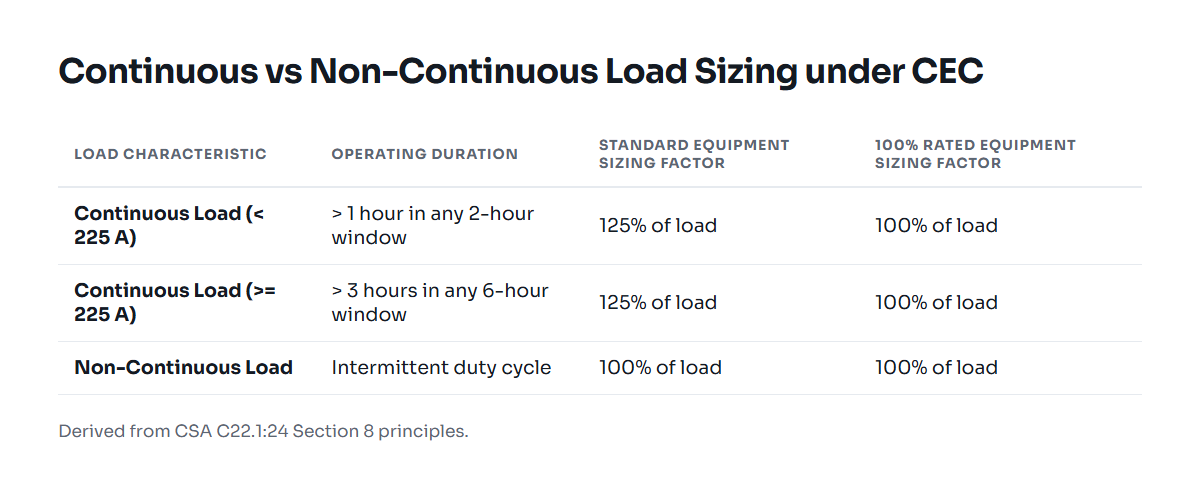
Section 8 also distinguishes between continuous loads and non-continuous loads. A continuous load operates for more than a total of 1 hour in any 2-hour period for loads rated under 225 A, or more than 3 hours in any 6-hour period for loads rated 225 A or greater. Unless electrical equipment and overcurrent devices are specifically certified for 100 percent continuous operation, service conductors and overcurrent devices must be sized so the continuous load does not exceed 80 percent of the protective device rating.
Engineers applying CEC Section 8 must understand the role of diversity. For an explanation of how code-approved multipliers reduce service sizes safely, read our guide on Demand Factor in Electrical Design: Practical Guide.
Practical Sizing: Worked Example for an Alberta Commercial Retail Facility
Consider a freestanding 500-square-metre commercial retail building located in Edmonton, connected to EPCOR's distribution grid at 120/208 V, three-phase, 4-wire.
Step 1: Inventory Connected Loads
- Basic retail lighting and receptacle load: 500 m² at 30 VA/m² = 15,000 VA (continuous)
- Rooftop HVAC package units: Two 10 kW mechanical units = 20,000 VA (non-continuous)
- Domestic electric hot water tank: 4,500 VA (non-continuous)
- Show window display lighting: 3,000 VA (continuous)
- Exterior parking and canopy lighting: 2,500 VA (continuous)
- Level 2 Dual Commercial EVSE: 19,200 VA (treated as continuous under CEC Section 86)
Step 2: Apply CEC Demand Rules and Continuous Load Factors
Separate loads into continuous and non-continuous categories:
- Continuous subtotal = 15,000 VA (general retail) + 3,000 VA (show window) + 2,500 VA (exterior lighting) + 19,200 VA (EVSE) = 39,700 VA.
- Non-continuous subtotal = 20,000 VA (HVAC) + 4,500 VA (water heater) = 24,500 VA.
- Because standard distribution equipment is rated for 80 percent continuous duty, the continuous portion must be divided by 0.80 (multiplied by 1.25): 39,700 VA / 0.80 = 49,625 VA.
- Total design service volt-amperes = 49,625 VA + 24,500 VA = 74,125 VA.
Step 3: Calculate Amperage at 120/208 V Three-Phase
Line current = Total Design VA / (Voltage × √3)
Line current = 74,125 VA / (208 V × 1.732) = 74,125 / 360.27 = 205.75 A
Step 4: Select Service Equipment and Conductors
Because the calculated current is 205.75 A, a standard 200 A service panel is undersized. The facility requires a standard 225 A or 400 A service entrance. Sizing to a 400 A main distribution panel provides immediate code compliance and spare capacity for future commercial tenant turnover.
| Load Category | Connected Load (VA) | Duty Rating | Design Factor | Sized Demand (VA) |
|---|---|---|---|---|
| Retail Area Base Allowance | 15,000 | Continuous | 125% | 18,750 |
| Exterior & Window Lighting | 5,500 | Continuous | 125% | 6,875 |
| Commercial EV Chargers | 19,200 | Continuous | 125% | 24,000 |
| HVAC Rooftop Units | 20,000 | Non-Continuous | 100% | 20,000 |
| Domestic Hot Water | 4,500 | Non-Continuous | 100% | 4,500 |
| Total Design Load | 64,200 | — | — | 74,125 |
In residential projects adding secondary suites, similar arithmetic determines whether the home's incoming 100 A service requires an upgrade. For specific Calgary requirements, review our analysis on Secondary Suite Electrical Service Upgrade Calgary.
Common Misconceptions in Electrical Service Sizing
Misinterpreting load sizing rules creates major delays, utility rejections, or unexpected construction costs. In practice, three misconceptions appear consistently on Alberta commercial and residential builds:
1. Sizing by Nameplate Total Alone
Contractors often sum the full nameplate rating of every breaker installed in a subpanel to claim a building needs an 800 A service when a 400 A service is adequate. Breakers indicate individual branch circuit safety thresholds, not actual draw. Summing breaker handles violates CEC Section 8 calculation principles and leads to expensive switchgear over-sizing.
2. Confusing Load Factor with Demand Factor
Engineers calculate load factor as the average power consumed over a given period divided by the peak power during that same period: Load Factor = (Total kWh consumed in period) / (Peak kW recorded × Hours in period). This differs from demand factor, which is the ratio of maximum demand to total connected load. Load factor describes operational energy efficiency and utility billing curves; demand factor sizes service equipment wires and switches.
3. Assuming the Electrical Utility Provides Service Based on Code Calculations
A CEC load calculation determines minimum service sizes to satisfy life safety and branch circuit protection. However, Alberta utilities (EPCOR, ENMAX, FortisAlberta, ATCO) size incoming utility transformers based on actual historical utility peak demand data, not CEC Section 8 calculations. A customer may submit a 400 A building service calculation, yet the utility may install a 75 kVA transformer based on real-world diversity curves. The building service equipment must still satisfy the CEC minimum.
Alberta Utility Coordination, Permits, and Building Energy Codes
Performing electrical load calculations and service sizing in Alberta requires coordination across three regulatory systems before power is turned on:
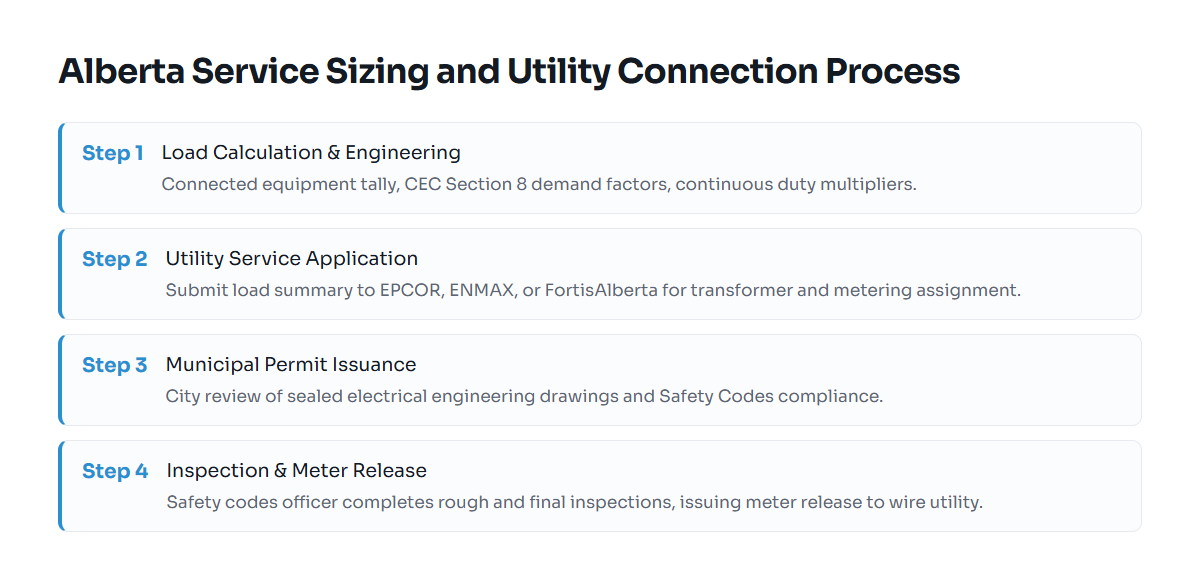
- Municipal Permitting Authorities: Municipalities like Calgary, Edmonton, Red Deer, and Lethbridge mandate electrical permits issued under the Safety Codes Act. Commercial tenant alterations, multi-family construction, and heavy service upgrades require signed, sealed engineering plans prepared by an electrical engineer registered with the Association of Professional Engineers and Geoscientists of Alberta (APEGA).
- Distribution Wire Owners: Connecting a new or upgraded service requires submitting an electrical load analysis and service request to the local wire service provider. FortisAlberta, EPCOR, and ENMAX enforce strict customer service entrance standards, governing metering equipment locations, CT cabinets, trenching depths, and available fault current values.
- Energy Codes: The National Energy Code of Canada for Buildings (NECB 2020) and Alberta Building Code set strict lighting power density caps and automated shut-off rules. These energy ceilings directly impact the input lighting calculations entered into your electrical load calculation tables.
Our team provides registered electrical engineering services in Alberta to ensure your load calculation submissions pass plan review, meet local utility requirements, and avoid costly transformer upgrade delays. You can also explore our technical library of engineering notes and insights for further guidance on power systems design.
Free tools: kVA to amps calculator