Adding a legal basement suite to an existing Calgary home almost always demands a secondary suite electrical service upgrade calgary homeowners must complete to meet safety codes. Most older Calgary homes operate on a 100-amp service. When you add an electric range, dedicated laundry, electric baseboard heating, or a modern heat pump for the suite, the calculated load exceeds 100 amps, requiring an upgrade to a 200-amp service, a panel replacement, and coordination with ENMAX Power Corporation.
Do You Need a Service Upgrade for a Calgary Suite?
A secondary suite adds an independent living space with its own kitchen, bathroom, sleeping area, and living area. From an electrical engineering perspective, this doubles your major domestic appliance count. An existing 100-amp service rarely has sufficient capacity to handle an electric range, separate clothes dryer, dishwasher, and dedicated heating circuits for a second unit.
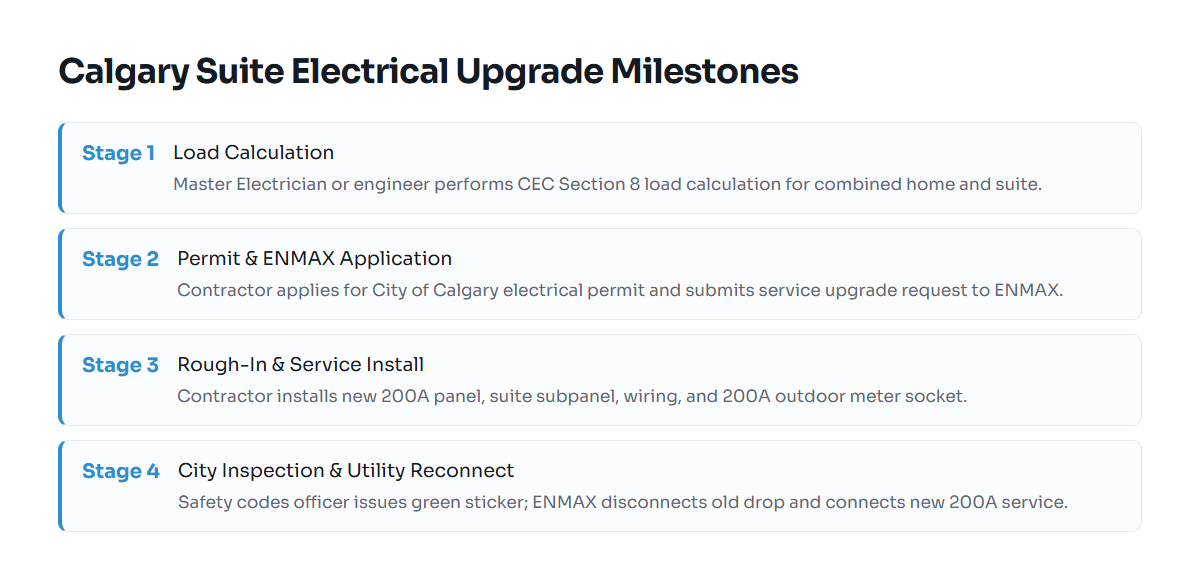
To establish whether an upgrade is mandatory, an electrician or engineer performs an electrical load calculation under Section 8 of the Canadian Electrical Code (CEC 2024). This calculation evaluates the primary dwelling and the suite together. If the calculated continuous and non-continuous demand exceeds 100 amps at 120/240 volts, you must upgrade your electrical service to 200 amps before the City of Calgary will approve your electrical permit.
Some homes with high-efficiency gas heating, a gas range, and a gas dryer can theoretically remain on 100 amps. However, if the tenant space relies on electric heating, an electric range, or if you plan to install an electric vehicle charger or central air conditioning, a 200-amp service upgrade becomes non-negotiable.
What the Service Upgrade Involves
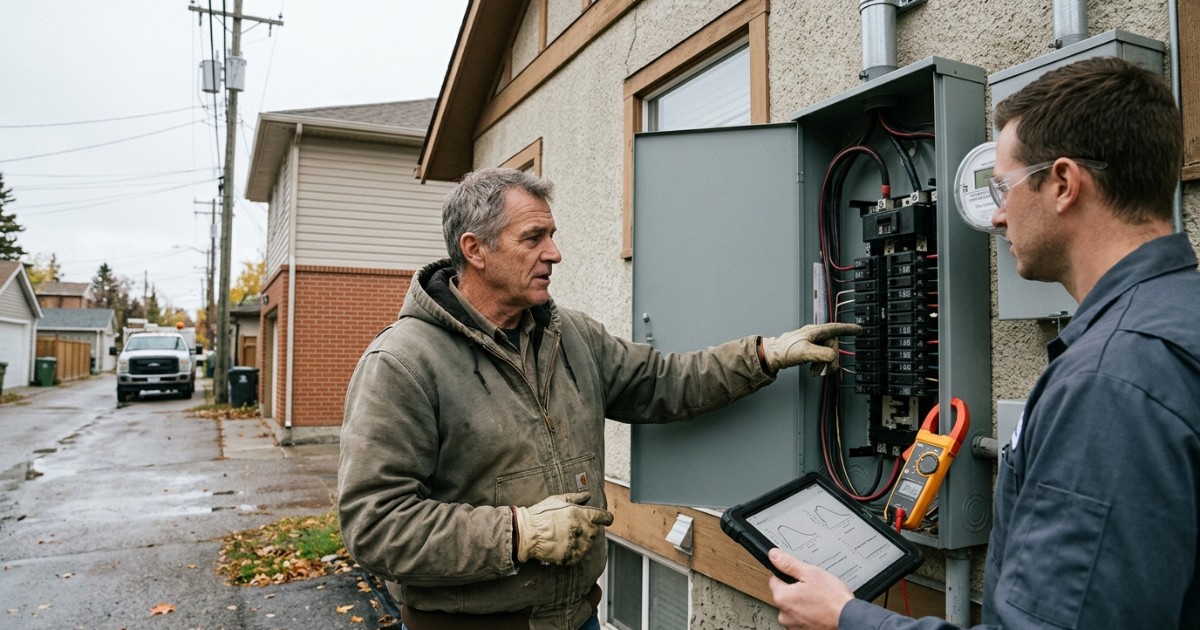
Upgrading a residential service is not simply swapping the breaker box inside the house. The work spans the equipment inside your mechanical room out to the utility point of connection at the property boundary.
Here is what the physical installation entails:
- Service Mast and Meter Base: The existing overhead conduit mast and meter base must be replaced with equipment rated for 200 amps. If your neighbourhood has underground utility feeds, the trenching, conduit run, and utility pull-box connection must align with ENMAX specifications.
- Main Service Panel: Your existing 100-amp breaker panel is replaced by a 200-amp main panel. This panel houses the main service disconnect breaker and provides adequate space for branch circuits.
- Subpanel for the Suite: While you can run suite circuits directly from the main panel, best practice is to install a 60-amp to 100-amp subpanel inside the secondary suite. This gives the tenant local access to their branch breakers without entering the primary residence.
- Earthing and Bonding: The grounding electrode conductor must be verified or replaced. Most older homes rely on copper water pipes for grounding, but the CEC requires connection to an approved ground electrode, such as two ground rods spaced at least 3 metres apart or an engineered plate electrode.
- Interconnected Smoke and Carbon Monoxide Alarms: Building safety codes require hardwired, interconnected smoke alarms between both suites so an alarm in the basement alerts the upstairs occupants immediately.
Worked Example: 100A vs 200A Load Analysis
Consider a typical 1,200-square-foot bungalow built in Calgary in 1972 with an existing 100-amp panel, natural gas furnace, and natural gas water heater. The owner intends to add an 800-square-foot legal basement suite with an electric range, electric clothes dryer, and baseboard supplemental heating.
| Load Component | Primary Dwelling (Main Floor) | Secondary Suite (Basement) | Combined Calculated Demand |
|---|---|---|---|
| Living Area Allowance | 1,200 sq ft base load | 800 sq ft base load | CEC Section 8 standard allocation |
| Cooking Appliances | Gas range (electric controls only) | Electric range (12 kW rating) | Full code demand factor applied |
| Laundry | Gas dryer (120V motor only) | Electric clothes dryer (5 kW) | Full rated nameplate allowance |
| Space Heating | Existing gas furnace | 2 x 1,500W electric baseboards | 3,000W at 100% demand factor |
| Total Calculated Demand | 34.5 Amps at 240V | 81.2 Amps at 240V | 115.7 Amps at 240V |
Because the total calculated demand of 115.7 amps exceeds the 100-amp threshold, a secondary suite electrical service upgrade calgary installation to 200 amps is legally mandatory. Retaining the 100-amp service would result in safety code violations, nuisance breaker tripping, and permit rejection.
Calgary and Alberta Permitting Requirements
In Alberta, electrical work is strictly regulated under the Safety Codes Act and the National Building Code (Alberta Edition). Work within Calgary must also comply with municipal development bylaws and local utility connection standards.
First, secondary suites must be legally registered with the municipality. The City of Calgary Secondary Suites program outlines the safety requirements, including ceiling height, fire separation, egress windows, and heating controls.
Second, you cannot pull a homeowner electrical permit for a secondary suite. Because a secondary suite is classified as a multi-family or rental dwelling, the City of Calgary requires an electrical contractor holding a valid Master Electrician certification in Alberta to pull the electrical permit. A homeowner permit is permitted only for single-family owner-occupied properties without rental suites.
Third, service connection requires coordination with ENMAX Power Corporation, the distribution wire owner for Calgary. ENMAX dictates the point of attachment, meter clearance, overhead line clearance, and transformer capacity. When upgrading to 200 amps, the contractor submits a service request to ENMAX. ENMAX verifies that the local distribution transformer on the street or alley can handle the added demand. Once the city safety codes inspector approves the rough-in and service installation, they issue a green inspection sticker and send authorization to ENMAX to energize the new 200-amp meter.
Choosing Between Single-Meter and Dual-Meter Configurations
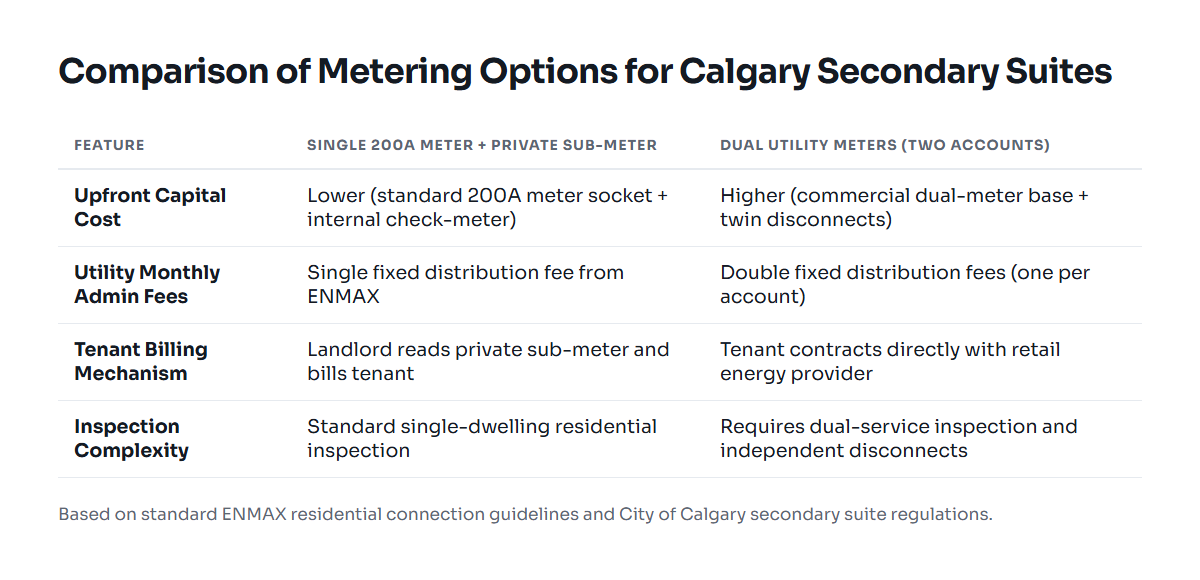
When planning your service upgrade, you must decide how electricity consumption will be billed. You have two primary options:
- Single 200-Amp Meter with Private Check-Meter: In this setup, ENMAX provides one 200-amp utility meter for the entire property. The property owner receives a single electrical bill. The electrical contractor installs a private, sub-meter (check-meter) inside the secondary suite panel. The landlord reads this meter monthly to calculate the tenant's exact share of power. This option has lower installation costs and avoids a second monthly fixed distribution fee from the utility.
- Dual Utility Meters (Independent Accounts): ENMAX installs a dual-meter base outside the home. Each suite has its own dedicated meter, main disconnect, and billing account directly with an energy retailer. The tenant pays the retailer directly. While this eliminates billing disputes, it carries higher capital costs for the dual-meter socket and equipment, and the property owner or tenant pays two separate monthly utility administration fees.
For most Calgary retrofit projects, a single 200-amp service with an owner-managed sub-meter offers the most cost-effective balance between construction expense and tenant utility management.
Steps to Prepare for Your Service Upgrade
Executing a service upgrade smoothly requires preparation before the electrician arrives on site. Review this checklist to prevent delays during permitting and construction:
- Audit Existing Appliances: List every major appliance in the main house and proposed suite. Record voltage, wattage, and fuel source (gas or electric) for stoves, dryers, water heaters, and heating equipment.
- Select Suite Heating Equipment: Choose your heating method early. Installing hydronic in-floor heat or a ductless mini-split heat pump significantly changes the calculated electrical load compared to standard resistive baseboard heaters.
- Check Meter Location Clearances: ENMAX requires specific working space around the outdoor electric meter. The meter cannot be blocked by decks, gas meters, air conditioner condensers, or tree branches. If your current meter is inside a car port or under a low deck, it must be relocated.
- Hire a Licensed Electrical Contractor: Obtain quotes from contractors experienced with City of Calgary safety codes officers and ENMAX work procedures. Ensure the contractor includes utility disconnect/reconnect fees in their scope of work.
- Consult an Engineer for Complex Additions: If your project involves a garden suite (backyard suite), commercial-style workshops, or simultaneous installation of two Level 2 EV chargers, engage our team for specialized electrical engineering services in Alberta. Complex loads often require load-sharing controllers or formal engineering demand analyses to optimize equipment sizing.
By calculating demand accurately, adhering to the CEC 2024, and following local utility procedures, your service upgrade will pass inspection without delay and safely power your Calgary home and rental suite for decades.
Free tools: kVA to amps calculator