A fire alarm verification company in Calgary inspects and tests newly installed or modified fire alarm systems to confirm compliance with CAN/ULC-S537 and the National Building Code (Alberta Edition). In Calgary, the verification agency must operate independently of the electrical installation contractor, test every field device and auxiliary circuit, and produce a formal verification report required by City of Calgary Safety Codes Officers before granting building occupancy.
The Role of a Calgary Fire Alarm Verification Agency
Fire alarm verification is a mandatory quality assurance procedure governed by Canadian standards. When an electrical contractor installs fire alarm equipment, wiring, or programming, the system cannot simply be energized and handed to the owner. Building codes require an independent third party to inspect and test the complete installation under CAN/ULC-S537, the Standard for Verification of Fire Alarm Systems.
The organization performing this work is commonly referred to as a verification agency or verification company. In practice, this work is completed by specialized fire alarm service companies employing certified technicians, often operating alongside the project's consulting electrical engineering services in Alberta. The primary deliverable is the fire alarm system verification report (often abbreviated as FAVR or FAVI report). This document confirms that the installation matches the engineered design drawings and that every device operates in accordance with manufacturer specifications and local codes.
For owners and general contractors, selecting the right verification provider prevents costly project delays. If the verification report identifies uncorrected deficiencies, or if the testing agency fails to test auxiliary interfaces like magnetic door holders or elevator recalls, the municipal safety codes officer will refuse to issue an occupancy permit.
What Fire Alarm Verification Work Involves Under CAN/ULC-S537
CAN/ULC-S537 mandates an exhaustive, device-by-device inspection. A verification is not a random sample audit or a quick commissioning check. The verification technician must physically inspect, test, and document 100 percent of all installed components. Detailed technical criteria are covered in our guide on CAN/ULC-S537 Verification Requirements in Alberta.
Field Device and Circuit Testing
Technicians verify device operation using specific physical tests rather than software bypasses:
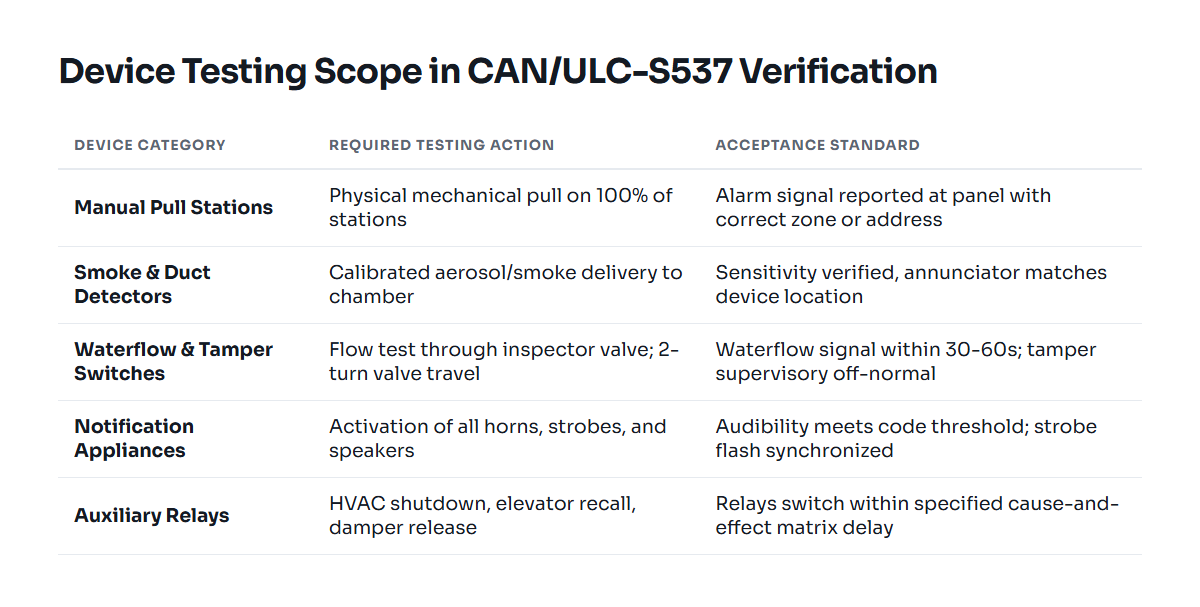
- Initiating Devices: Every manual pull station is pulled. Smoke detectors are tested using calibrated aerosol or manufacturer-approved smoke delivery tools to confirm sensitivity and alarm state. Heat detectors are tested using controlled heat sources or mechanical activation for restorable units. Duct smoke detectors are checked for differential air pressure and proper sampling tube orientation.
- Notification Appliances: Horns, strobes, and speakers are activated to confirm operational status, strobe synchronization, and audibility levels. Sound pressure levels must meet the minimum thresholds established by building regulations, typically 75 dBA at the bed pillow in residential sleeping areas and 10 dBA above ambient noise levels in commercial spaces.
- Supervisory Devices: Sprinkler system control valves are exercised to confirm that closing a valve sends an audible and visual supervisory signal within two full turns or off-normal travel. Pressure switches and waterflow alarm switches are flowed to verify retard settings, typically 30 to 60 seconds to prevent false alarms from municipal water surges.
- Circuit Integrity: Signaling Line Circuits (SLC), Notification Appliance Circuits (NAC), and Initiating Device Circuits (IDC) are subjected to simulated fault conditions. Technicians induce open circuits, ground faults, and short circuits to ensure the control panel correctly reports trouble conditions without failing non-isolated segments.
Emergency Power and Battery Calculations
CAN/ULC-S537 requires the system to undergo an emergency power transfer test. The main AC disconnect is opened, running the system entirely on secondary battery power. Technicians verify that the panel continues to operate under quiescent (standby) supervisory conditions for the prescribed duration (typically 24 hours), followed immediately by full alarm load operation for the duration required by the building code (typically 30 minutes for emergency voice communication buildings or 60 minutes for high-hazard occupancies). The technician measures voltage drop, terminal voltage under load, and charger recovery current.
Auxiliary Integrations
The verification agency must confirm that output relays trigger ancillary life safety functions according to the engineering sequence of operations:
- Air-handling unit shutdown to prevent smoke migration.
- Elevator primary and alternate floor recall.
- Fire damper release and magnetic door holder release upon alarm initiation.
- Kitchen fire extinguishing system supervisory and alarm monitoring.
- Off-site monitoring panel signaling through primary and secondary communication channels.
Alberta and City of Calgary Jurisdictional Requirements
In Alberta, the legal requirement for fire alarm verification comes directly from the National Building Code (Alberta Edition) 2023, specifically Division B, Article 3.2.4.22. This article mandates that any newly installed fire alarm system, as well as any addition or modification to an existing system, must be verified in accordance with CAN/ULC-S537 before the system is placed in operation.
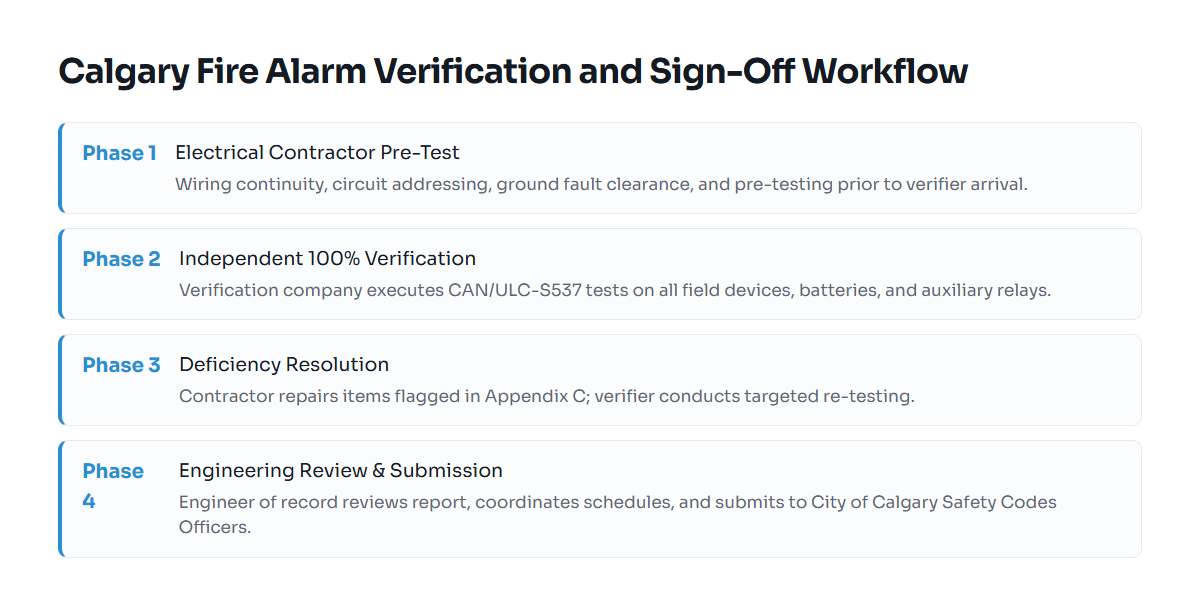
The City of Calgary enforces this requirement strictly through the Calgary Building Approvals and Electrical Inspections departments. Before a Safety Codes Officer (SCO) conducts a final building or electrical inspection, the complete verification report must be uploaded to the municipal permit portal or presented on site. If the verification report indicates outstanding deficiencies (documented in Appendix C of the CAN/ULC-S537 standard), the City will withhold the final inspection sign-off and the Certificate of Occupancy.
For projects requiring professional involvement under the Alberta Safety Codes Act and the Engineering and Geoscience Professions Act, the fire alarm system design engineer must review the verification report. The engineer confirms that the installation satisfies the engineered drawings and specifications before submitting professional schedules and documentation to the municipality. The broader engineering framework is detailed in our overview of Fire Alarm Design and Verification Under CAN/ULC.
How to Choose a Fire Alarm Verification Company in Calgary
Choosing the right verification partner requires evaluating independence, technician credentials, and project coordination capacity. The table below outlines how responsibilities are distributed across the project team during commissioning:
| Role | Primary Organization | Key Responsibilities | Required Sign-Off |
|---|---|---|---|
| System Installer | Electrical Contractor | Pulls cable, mounts devices, lands conductors, terminates panels, and conducts pre-testing. | Permit sign-off, installer declaration. |
| Verification Agency | Independent Fire Alarm Specialist | Performs 100% device testing, tests wiring integrity, verifies secondary power, and checks sequence of operations. | CAN/ULC-S537 Verification Certificate and Report. |
| Engineer of Record | Professional Engineering Firm (APEGA) | Prepares design drawings, reviews shop drawings, evaluates verification report, and validates code compliance. | Letters of Representation / Schedules to the AHJ. |
| Safety Authority | City of Calgary Building & Electrical Inspections | Reviews engineering documents, inspects general installation, checks verification documentation, and grants occupancy. | Final Inspection and Certificate of Occupancy. |
Key selection criteria when contracting a verification firm in Calgary include:
- Operational Independence: Under CAN/ULC-S537, the verification agency must be independent of the installing electrical contractor. While an electrical contractor can pull wire and terminate devices, an affiliated installer cannot verify their own installation. The verifier acts as an unbiased inspection body.
- Technician Certification: Technicians should hold registration with the Canadian Fire Alarm Association (CFAA) or demonstrate equivalent manufacturer training for complex, proprietary network systems (such as Simplex, Notifier, or Edwards).
- Coordinated Reporting: The agency must produce reports using the standardized forms found in CAN/ULC-S537. Unstructured checklists or proprietary software summaries that do not match the standard will be rejected by Calgary Safety Codes Officers.
- Direct Engineering Coordination: Complex buildings with smoke control or phased evacuation require a verification firm that can communicate directly with the electrical consulting engineer to resolve sequence-of-operation discrepancies without project delays.
What to Have Ready Before Verification Begins
Verification is the final technical step before authority inspection. When projects schedule verification before the site is truly ready, technician hours multiply and re-inspection charges accumulate. You can read more about financial variables in our Fire Alarm Verification Cost in Alberta: Pricing Guide.
Before scheduling a verification company on site, ensure the following items are complete:
- 100 Percent Pre-Testing by the Electrician: The electrical contractor must complete installation and continuity testing. Ground faults, open circuits, and addressing errors must be cleared before the verifier arrives.
- Approved Shop Drawings and Sequence Matrix: Provide the verifier with the electrical engineer's sealed drawings, manufacturer shop drawings, and the project cause-and-effect matrix.
- Trade Coordination: Arrange on-site support from mechanical contractors (for fan shutdowns and damper operation), elevator mechanics (for recall testing), and sprinkler fitters (for waterflow switch testing).
- Access Equipment: Provide ladders, scissor lifts, and access keys for all locked utility, electrical, and mechanical rooms.
Worked Scenario: Commercial Bay Tenant Improvement in Southeast Calgary
Consider a 12,000-square-foot industrial bay build-out in the Foothills Industrial Park. The scope includes adding a new mezzanine office area, two warehouse unit heaters, a sprinkler riser, and four duct-mounted smoke detectors.
The installation comprises 24 addressable optical smoke detectors, 6 manual pull stations, 14 horn/strobe notification appliances, 2 sprinkler tamper switches, 1 waterflow switch, and 4 duct smoke detectors wired to an existing building panel via a local transponder.
The verification sequence unfolds over two distinct phases:
- Pre-Verification Review: The verifier reviews the manufacturer program printout and matches device serial numbers against the engineer's plan drawings.
- Site Execution (16 Field Hours): The verification technician physically triggers all 24 smoke detectors with aerosol, tests pull stations, flows the inspector's test valve to measure waterflow delay (recorded at 42 seconds), and introduces line faults on both Signaling Line Circuits. During HVAC testing, duct detector #3 fails to shut down rooftop unit RTU-2 due to an unpowered auxiliary control relay.
- Deficiency Resolution: The electrical contractor fixes the relay wiring the same afternoon. The technician re-tests the circuit, confirms fan shutdown, and updates Appendix C of the report to show the deficiency cleared.
- Handoff: The final 28-page CAN/ULC-S537 verification report is compiled, stamped by the verification technician, and submitted to the consulting engineer for review before filing with the City of Calgary Electrical Inspection portal.
To discuss fire alarm system engineering, peer reviews, or verification coordination on commercial, residential, or industrial projects across Calgary, contact Amplify Design at 825-438-1945 or submit project drawings for an engineering proposal.
Free tools: kVA to amps calculator