What Is Fire Alarm Verification?
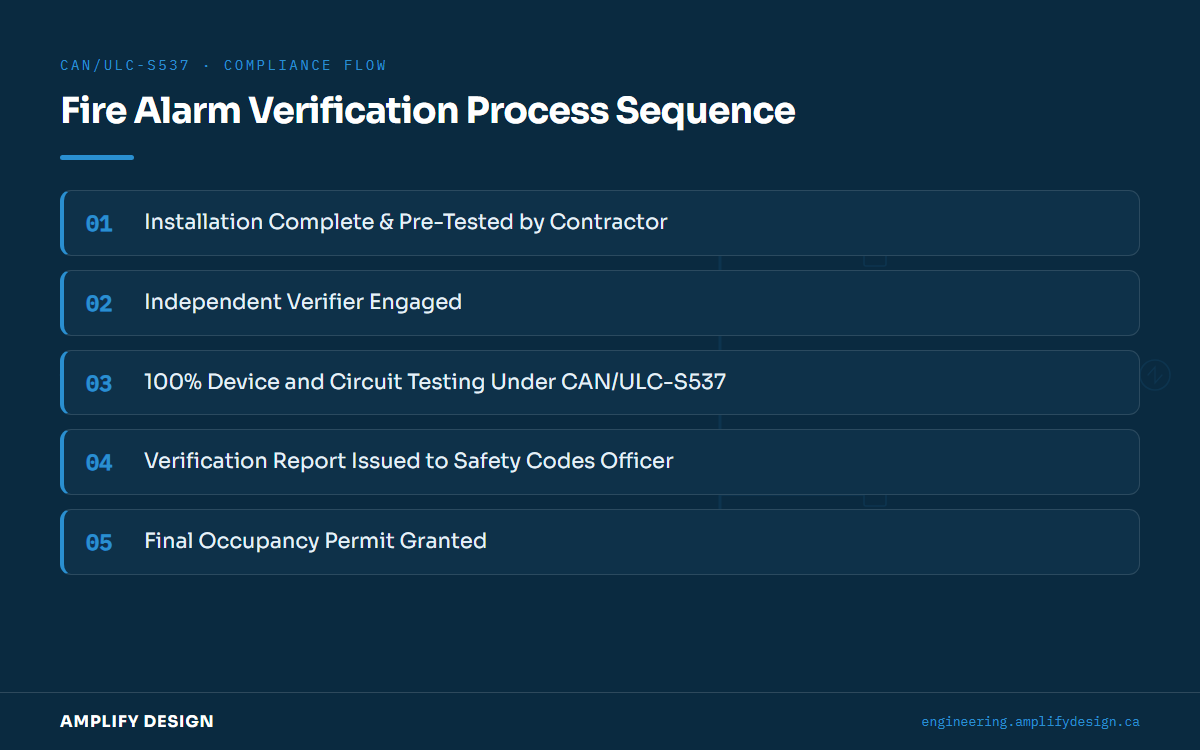
Fire alarm verification is a mandatory third-party inspection and physical testing process that confirms a newly installed, modified, or extended fire alarm system operates strictly according to CAN/ULC-S537 standards and local building codes. An independent qualified verifier must test every device, wiring circuit, and control function before an authority having jurisdiction issues an occupancy permit. This procedure proves that the physical installation matches the engineered design drawings and that all field components communicate accurately with the main control unit.
Code Requirements for Fire Alarm Verification
The National Building Code — 2023 Alberta Edition (NBC(AE)) requires fire alarm verification on all new fire alarm system installations and alterations to existing systems. Section 3.2 of the NBC(AE) mandates that the system installation comply with CAN/ULC-S524 (Standard for Installation of Fire Alarm Systems) and be verified in accordance with CAN/ULC-S537 (Standard for Verification of Fire Alarm Systems).
Complementing the building code, Section 32 of the Canadian Electrical Code (CEC 2024) outlines the wiring methods, power supply connections, and circuit integrity requirements for fire alarm systems. Electrical contractors integrated with our electrical engineering services in Alberta coordinate these code provisions early to avoid failed verifications. The building official or safety codes officer will not grant building occupancy without an un-remarked CAN/ULC-S537 verification report signed by the qualified verifier.
How Verification Works on Construction Sites
Verification takes place after the electrical contractor completes the system installation, performs pre-testing, and confirms the building envelope is secure. The verifier cannot be the installing contractor or the system designer; CAN/ULC-S537 mandates an independent party to maintain objectivity.
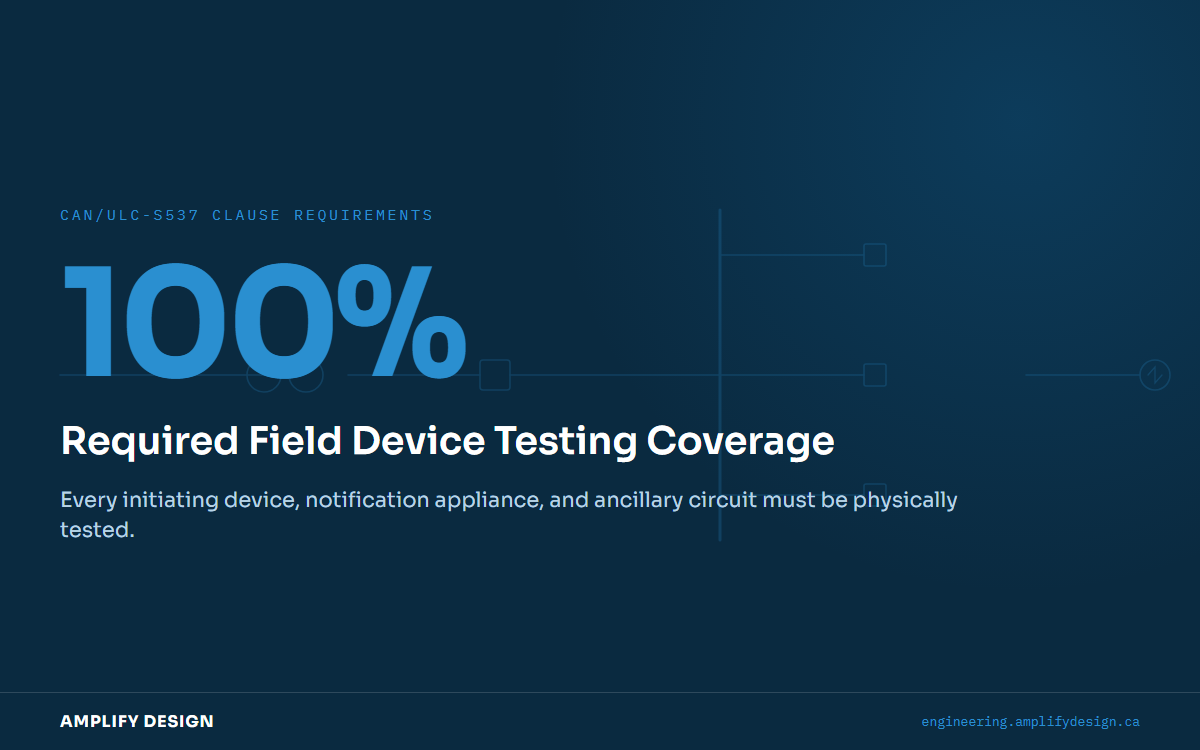
During field testing, the verifier systematically checks 100 percent of all connected field devices. This process includes:
- Initiating Devices: Actuating manual pull stations, introducing real smoke into smoke detectors, heat-testing thermal detectors, and tripping waterflow switches.
- Notification Appliances: Measuring sound pressure levels (dBA) in ambient conditions and verifying strobe flash rates across all notification zones.
- Circuit Fault Simulation: Creating deliberate open circuits, ground faults, and short circuits on Signaling Line Circuits (SLC) and Initiating Device Circuits (IDC) to confirm the panel reports trouble signals correctly.
- Ancillary Control Functions: Verifying that the fire alarm control panel successfully releases magnetic door holders, shuts down air handling units, signals elevator recall, and trips fire dampers upon alarm activation.
- Secondary Power Supply: Disconnecting main AC power to test standby battery operation under full load conditions for the duration required by code.
Key Differences: Verification vs. Annual Inspection vs. Commissioning
Industry terms often cause confusion among building owners and project managers. Each process serves a distinct legal and operational purpose:
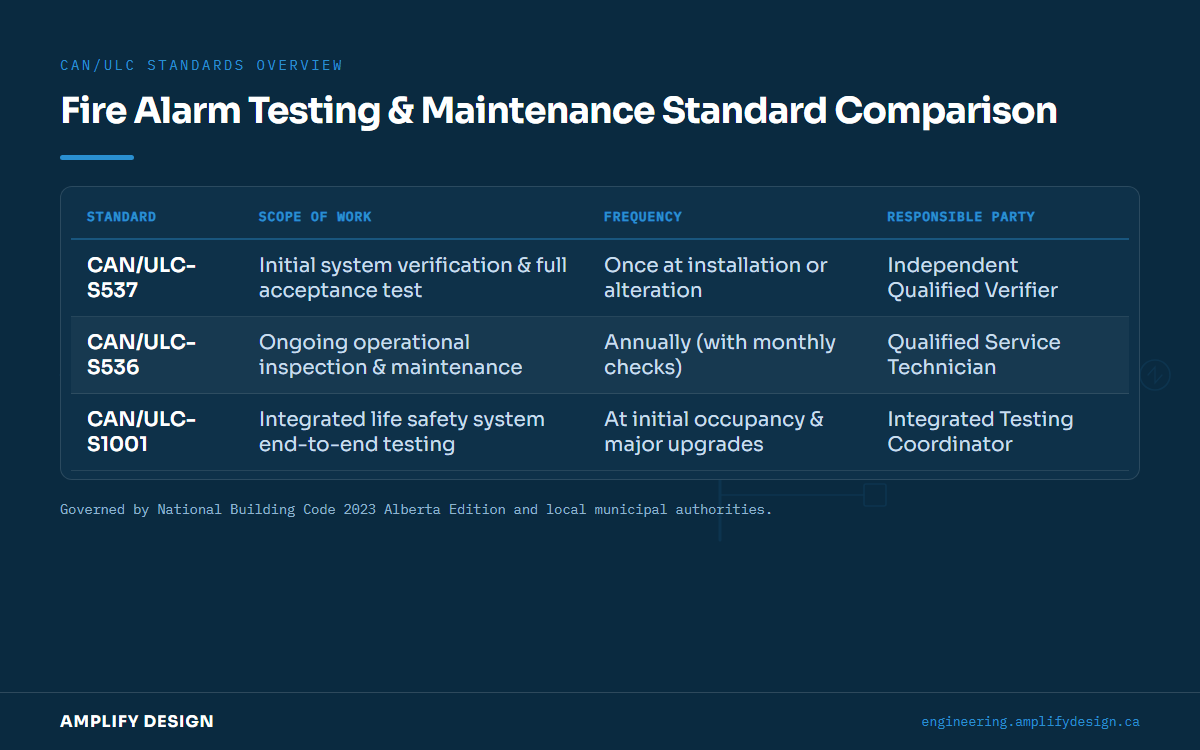
- Initial Verification (CAN/ULC-S537): A detailed, one-time acceptance test of a new or modified system. Every single device and circuit wiring connection is tested before initial building occupancy.
- Annual Inspection (CAN/ULC-S536): Periodic testing required yearly throughout the operational life of the building to confirm ongoing maintenance and operability.
- Integrated Systems Testing (CAN/ULC-S1001): End-to-end testing of how the fire alarm system interacts with other active building fire safety systems, such as smoke control, generator power transfer, and sprinkler pressure switches.
Electrical engineers draft verification specifications long before construction begins. Browse our engineering notes and insights for details on system zoning, riser diagrams, and battery sizing calculations.
Documentation and Occupancy Approval
Upon completing field tests, the verifier issues a formal CAN/ULC-S537 Verification Report. This document includes a comprehensive device record, circuit configuration logs, voltage drop readings, and explicit confirmation of system pass or fail status. If any device fails, the contractor must rectify the wiring or hardware defect and schedule a re-test.
The completed, signed report is submitted to the Safety Codes Officer and the engineer of record. Once accepted, the fire alarm system is recognized as fully operational, allowing the municipality to grant final occupancy for the building.
Free tools: kVA to amps calculator