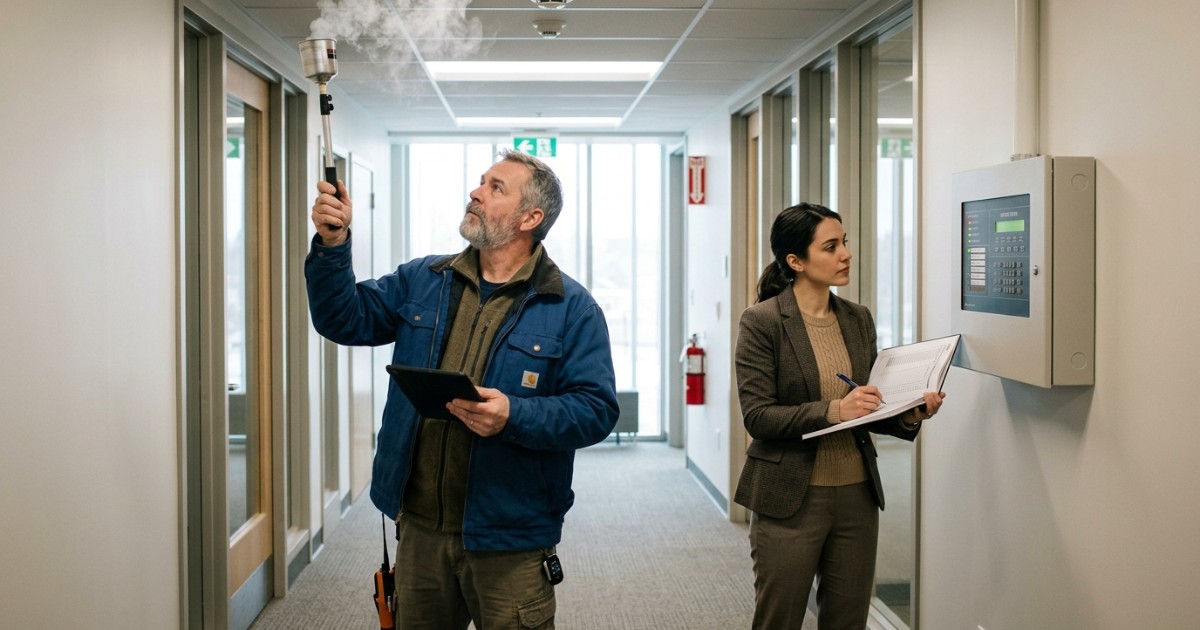
CAN/ULC-S537 verification requirements dictate that every new, modified, or upgraded fire alarm installation in Alberta must undergo rigorous, documented physical testing before a building receives an occupancy permit. Mandated under the National Building Code (2023 Alberta Edition), this process requires an independent, qualified technician to inspect every initiating device, notification appliance, supervisory switch, and control panel function to confirm full compliance with design drawings and installation standards.
Understanding CAN/ULC-S537 Verification Requirements
The standard CAN/ULC-S537, titled Verification of Fire Alarm Systems, sets the benchmark for inspecting life safety installations across Canada. While CAN/ULC-S524 dictates how contractors install wiring, conduits, and equipment, ULC S537 establishes how specialists inspect and validate that equipment before life safety systems go live. In Alberta, verification of fire alarm systems is not an optional quality check; it is a statutory legal milestone enforced by municipal safety codes officers.
Fire alarm verification confirms two separate conditions: operational integrity and wiring supervision. A device can be wired to sound an audible signal when tested, yet still fail supervision if an open circuit, ground fault, or short circuit fails to register a trouble condition on the main panel. CAN/ULC-S537 verification requirements require technicians to induce deliberate electrical faults at field terminals to prove the central panel correctly identifies and reports trouble signals in real time.
Building owners often confuse an annual fire alarm inspection with a fire alarm verification. An annual inspection follows CAN/ULC-S536 and reviews operational performance over the preceding twelve months. In contrast, fire alarm system verification under S537 occurs when a system is newly installed, expanded, or altered. It establishes the baseline operational record against which all future annual inspections are evaluated. For complex facilities, our electrical engineering services in Alberta help clients plan these verifications early to prevent occupancy delays.
The Governing Rules Under the Alberta Building Code
The legal mandate for verification originates in the National Building Code – 2023 Alberta Edition [NBC(AE) 2023], specifically Article 3.2.4.22. This article mandates that any newly installed fire alarm system, as well as any addition or modification to an existing system, must be verified in conformance with CAN/ULC-S537. You cannot legally obtain an occupancy certificate in Alberta without an executed fire alarm verification report.
The standard requires strict organizational independence. The technician conducting the verification cannot be the same individual who installed the physical wiring and devices. While the electrical contractor provides site support to open junction boxes and rectify crossed wires, an independent, certified fire alarm technician, often registered with the Canadian Fire Alarm Association (CFAA) or factory-certified by the manufacturer, must oversee and document the testing. For engineered life safety designs, the Professional Engineer of Record reviews this completed document as part of general engineering review before issuing APEGA Schedules.
NBC(AE) 2023 also establishes strict guidelines for residential units, sleeping areas, and industrial facilities. Under Alberta building code smoke detectors requirements, interconnected smoke alarms in individual dwelling units do not replace a full building fire alarm system when building height, occupant load, or major occupancy classifications trigger Article 3.2.4.1. When an engineered fire alarm system is mandated, duct detectors, elevator recall sensors, and residential common-area detectors fall directly under CAN/ULC-S537 test protocols.
Subsystem Verification Protocols and Pass Criteria
Every verification follows standardized forms containing pass-or-fail line items across the entire building infrastructure. The following table highlights the critical operational subsystems evaluated under CAN/ULC-S537, alongside their mandatory field pass criteria:
| Subsystem / Parameter | Reference Standard | Testing Requirement | Pass Criteria |
|---|---|---|---|
| Device Supervision | CAN/ULC-S537 Section 5 | Induce open-circuit, short-circuit, and ground fault conditions on field circuits. | Control panel reports correct circuit trouble within standard response time; no unhandled fault. |
| Initiation Devices | CAN/ULC-S537 Section 5 | 100% physical trip of all manual stations, heat detectors, and smoke detectors. | Panel logs correct address, zone, and descriptor; annunciator matches geographic placement. |
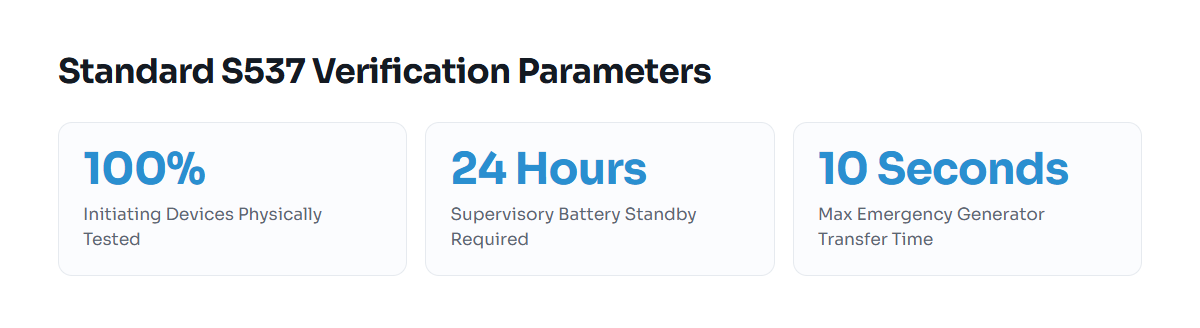
| Secondary Power Supply | CAN/ULC-S537 Section 4 | Disconnect primary AC breaker; operate panel under battery power. | 24 hours supervisory operation followed by full rated alarm time without system failure. |
| Emergency Power Transfer | CSA C282 / NBC(AE) | Simulate utility outage; verify transfer switch and generator interface signals. | Generator start signal issued; emergency bus powers life safety equipment within 10 seconds. |
| Ancillary Control | CAN/ULC-S537 Section 6 | Trigger fire alarm; verify shutoff relays, damper closures, and elevator recall circuits. | Fans de-energize; magnetic hold-opens release; elevators recall to designated egress floor. |
Worked Example: 4-Storey Mixed-Use Building in Alberta
Consider a practical engineering scenario: a 4-storey commercial and residential building in Calgary with retail suites on the ground floor and 36 residential units above. The life safety infrastructure consists of an addressable fire alarm panel, 140 field initiation devices, 48 horn-strobe notification appliances, 4 duct smoke detectors, magnetic door holders, and a natural-gas standby generator.
1. Initiating Device and Signaling Inspection
Technicians must inspect 100% of the 140 initiation devices. This includes manual pull stations, area smoke detectors, sprinkler tamper switches, and waterflow switches. Under CAN/ULC-S537, testing a statistical sample is explicitly prohibited; every individual addressable device must be manually triggered. When testing a thermal detector, an artificial heat source applies temperature until the contact closes. For addressable smoke sensors, aerosol smoke triggers the sensor, verifying both physical sensing chamber function and address transmission back to the control panel.
2. Secondary Battery Calculations and Testing
The control panel relies on sealed lead-acid batteries. The design documents specify a total supervisory quiescent current of 1.25 Amps and a full-alarm load current of 8.50 Amps. Under NBC(AE) 2023 Subsection 3.2.4, the secondary power supply must provide 24 hours of supervisory standby followed by 30 minutes (0.5 hours) of full emergency alarm load. Using standard battery calculations with a 20% safety factor (1.2 multiplier):
- Supervisory consumption: 1.25 A × 24 h = 30.00 Ah
- Alarm load consumption: 8.50 A × 0.5 h = 4.25 Ah
- Required base capacity: 30.00 Ah + 4.25 Ah = 34.25 Ah
- With safety factor: 34.25 Ah × 1.20 = 41.10 Ah minimum
The installation uses a 50 Ah battery set. During verification, the technician disconnects AC mains power to evaluate battery voltage under load, logs voltage drops across 24 hours, and ensures the panel transfers to secondary power without dropping supervisory signals. To evaluate additional life safety infrastructure costs on similar sites, read our breakdown of Fire Alarm Verification Cost in Alberta: Pricing Guide.
3. Standby Power and Generator Interfaces
Where buildings include an emergency generator, life safety generator requirements governed by CSA C282 interact directly with the fire alarm panel. The verification technician validates that emergency power transfer switches report operational status to the fire alarm control panel. When utility power drops out, the fire alarm panel must record an emergency power transfer trouble condition, run on battery supply during the generator startup window, and transition to generator power without generating system resets or spurious false alarms.
Common Field Failures and Compliance Traps
Fire alarm verifications regularly encounter delays due to installation defects or documentation mismatches. Identifying these common failure points early keeps project schedules on track.
1. Ancillary System Integration Failures
CAN/ULC-S537 requires complete functional testing of every auxiliary contact. Mechanical air-handling units must shut down on duct smoke detection to prevent toxic smoke migration across fire compartments. Often, mechanical contractors wire control relays without coordinating with the fire alarm technician. If the HVAC fans fail to stop, or fire-rated motorized dampers fail to drop upon alarm initiation, the entire verification sequence fails, preventing permit issuance.
2. Incorrect Alarm Verification Algorithms
Modern addressable systems use an alarm verification facility (often referenced as real-time alarm verification) on smoke detector circuits to prevent false trips from dust or minor air disturbances. This feature delays full building evacuation signals while the detector resets and verifies smoke presence over a timed window (typically 15 to 60 seconds). However, CAN/ULC-S524 strictly prohibits enabling alarm verification on manual pull stations, waterflow switches, or duct detectors. Technicians frequently find that programmer error has globally applied this verification delay across all initiating circuits, violating life safety code requirements.
3. Defective Off-Site Communication Paths
Article 3.2.4.8 of the building code requires signal transmission to an accredited fire department or central monitoring agency. Under CAN/ULC-S537 Section 5, signal transmission must confirm distinct signals for alarm, supervisory, and trouble conditions. Installers commonly wire monitoring transmitters as simple binary dry-contact loops that report supervisory faults as general troubles. The verification technician must reject this configuration because off-site monitoring operators must receive accurate, differentiated signal codes.
4. Incomplete Fire Alarm Verification Report Calgary Submissions
When working within southern Alberta jurisdictions, obtaining a fire alarm verification report Calgary submission approval requires rigorous documentation. Municipal safety codes officers review S537 reports alongside engineering letters of compliance. Common paperwork rejections occur when reports omit technician certification IDs, lack battery capacity calculation appendices, or exclude marked-up as-built riser diagrams. You can read more about engineering expectations in our review of What Is Fire Alarm Verification? Alberta Building Code Guide.
Step-by-Step Fire Alarm Verification Checklist
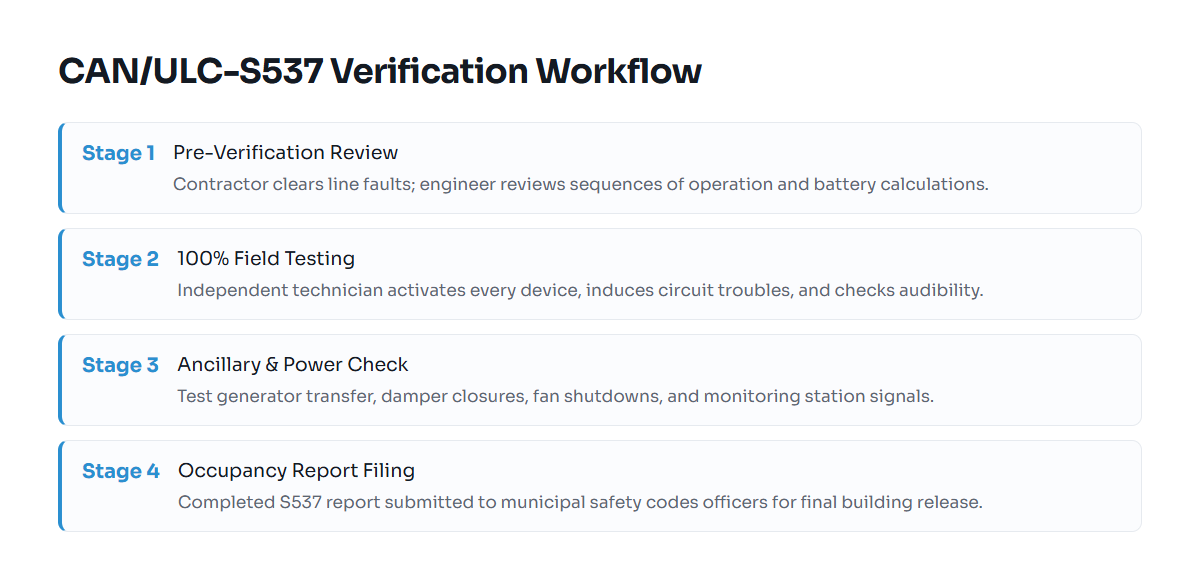
To prepare an Alberta commercial or multi-family project for a seamless verification, adhere to this logical four-stage engineering sequence:
-
Pre-Verification Documentation and Readiness:
- Assemble sealed engineering drawings, device riser diagrams, and battery sizing sheets.
- Verify all electrical trades have cleared ground faults, open lines, and address conflicts.
- Confirm the central fire alarm panel software matches the latest approved sequence of operations.
-
Wiring Supervision and Circuit Testing:
- Disconnect field conductors on every Signaling Line Circuit (SLC) to verify trouble recognition.
- Introduce artificial earth grounds on positive and negative field lines to prove ground fault detection.
- Test notification appliance circuits (NAC) under short and open conditions to ensure panel supervision.
-
Device Function and Physical Verification:
- Functionally actuate 100% of initiating devices, checking custom alphanumeric address displays.
- Measure audibility sound pressure levels (dBA) in sleeping areas and common paths using calibrated sound meters.
- Ensure visual strobe synchronization operates correctly across common corridors and large suites.
-
Ancillary Integration and Sign-Off:
- Confirm mechanical air handler interlocks, fire door releases, and elevator capture circuits trigger reliably.
- Verify dual-path fire monitoring panel communications to the ULC-listed central monitoring station.
- Sign and seal the final CAN/ULC-S537 report, append device test sheets, and transmit the package to the municipal safety codes authority.
For deeper insight into regulatory standards governing fire alarm planning, consult our reference resource on Fire Alarm Design and Verification Under CAN/ULC.
Free tools: kVA to amps calculator