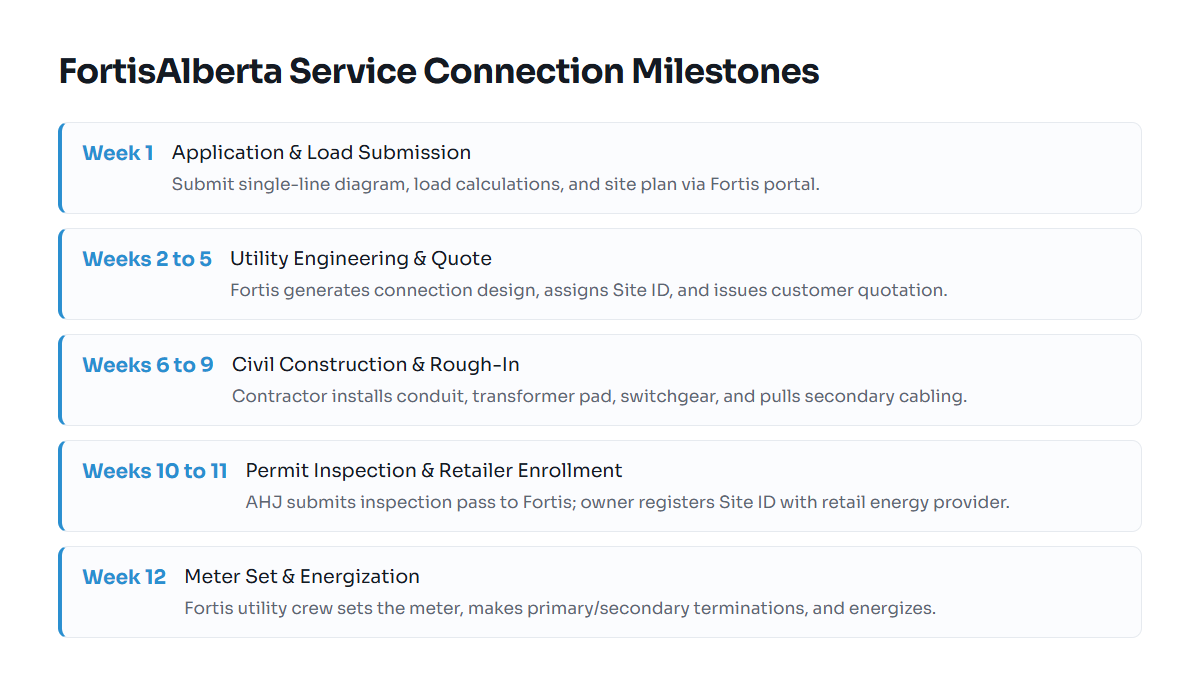
To connect a new or upgraded electrical service in FortisAlberta service territory, you must submit a service connection request with a calculated load, execute a customer quotation, install the required civil infrastructure, obtain an electrical permit inspection pass from the local safety codes authority, and enroll your designated Site ID with a competitive retail electricity provider. FortisAlberta will not schedule meter installation or service energization until the safety codes inspection sign-off and retailer enrollment both clear in their system.
Understanding the Alberta Utility and Safety Codes Framework
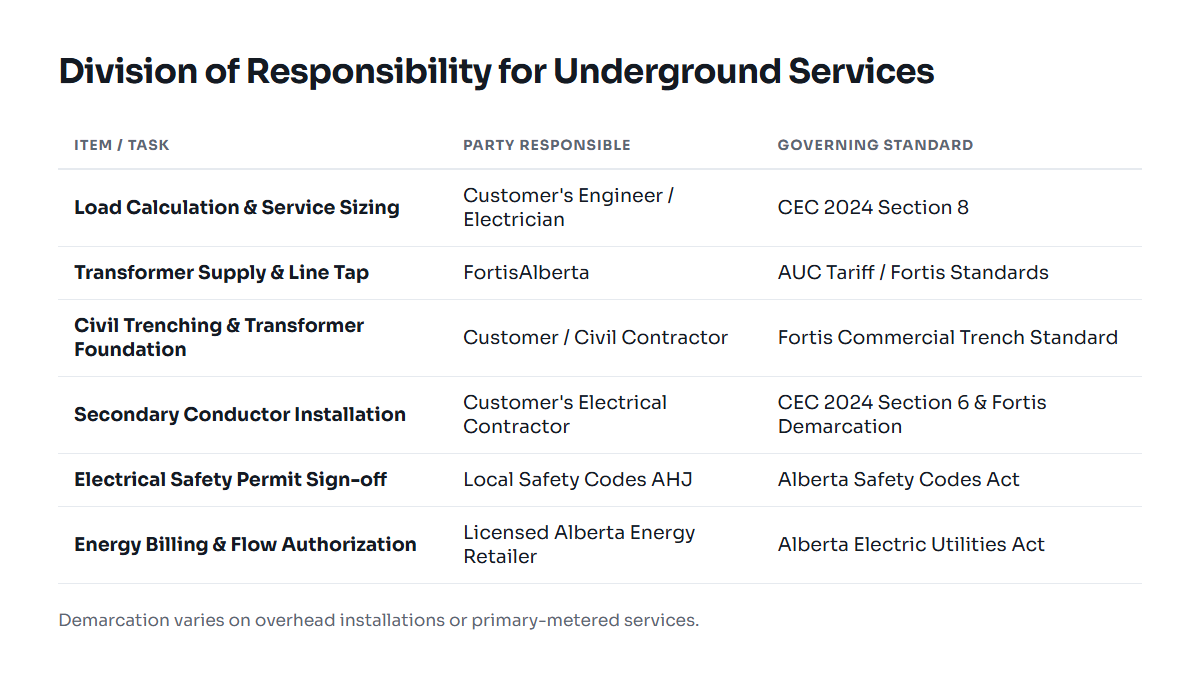
Electrical connections in Alberta operate under a deregulated electricity market and a strict division of responsibility between the distribution wire service provider, the competitive retailer, and the Safety Codes Authority Having Jurisdiction (AHJ). FortisAlberta owns and operates the poles, wires, and utility transformers across much of rural and suburban Alberta. They do not sell the electricity that flows through those wires, and they do not inspect building electrical wiring.
Three distinct frameworks govern any FortisAlberta service application:
- FortisAlberta Customer Terms and Conditions for Electric Distribution Service: Approved by the Alberta Utilities Commission (AUC), these rules govern service demarcation points, cost contributions, trenching obligations, and meter socket configurations.
- The Alberta Safety Codes Act and Permit Regulations: You must pull an electrical permit through the municipality or an authorized inspection agency (such as IAPO, Park Inspections, or The Inspections Group) before work begins. FortisAlberta cannot energize wiring without an official permit release from the AHJ.
- Canadian Electrical Code Part I (CEC 2024): Section 6 dictates the sizing and arrangement of customer-owned service entrance equipment, metering conductors, and consumer service heads. Where FortisAlberta standards require higher clearances or specific conduit sweeps, their utility standards take precedence over CEC minimums on the supply side of the demarcation point.
For systems with complex metering or higher voltage levels, review our guide on Primary vs Secondary Metering in Alberta to determine if high-voltage delivery makes economic sense for your facility.
Worked Example: New 400 A Commercial Service
Consider a new 700 m² commercial shop located in Rocky View County. The building requires a 120/208 V, 3-phase, 4-wire, 400 A electrical service fed underground from an existing FortisAlberta three-phase overhead powerline across the roadway.
Step 1: Electrical Load Calculation
The engineer calculates the consumer service demand in accordance with CEC 2024 Section 8. The continuous heating, lighting, and general motor loads produce a calculated design load of 88 kVA (244 A at 208 V). The service entrance switchboard is sized at 400 A to permit future tenant expansion.
Step 2: Service Application Submission
The applicant creates a project on the FortisAlberta portal. The application includes:
- Legal Land Description (LLD) and municipal address.
- Site plan showing the proposed building footprint, property lines, and requested utility transformer location.
- Single-line diagram detailing the 400 A service entrance, main disconnect rating, and meter base type.
- Load breakdown: 88 kVA operating demand and 144 kVA maximum future connected capacity.
Step 3: Engineering Review and Quotation
FortisAlberta reviews utility line capacity. To supply 88 kVA, FortisAlberta assigns a standard 112.5 kVA three-phase padmount transformer. FortisAlberta provides a Customer Connection Quotation detailing:
- The utility connection fee, accounting for the FortisAlberta investment allowance based on anticipated kilowatt-hour consumption.
- The utility-designated point of service demarcation (in this underground arrangement, the secondary lugs on the utility padmount transformer).
- The assigned 13-digit Site Identification number (Site ID).
Step 4: Civil Works and Trenching
Under FortisAlberta commercial standards, the customer provides trenching and conduit on private property. The contractor installs:
- Two 103 mm (4-inch) rigid PVC conduits from the electrical room to the transformer concrete pad location, buried to a minimum depth of 1.0 m below finished grade.
- Conduit sweeps at the pad foundation with minimum 914 mm (36-inch) radius bends.
- Four 500 kcmil copper conductors per phase plus neutral, pulled from the main disconnect switchboard to the transformer pad ready for Fortis utility crews to terminate.
| Milestone | Responsible Party | Documentation Required | Typical Duration |
|---|---|---|---|
| Load and site plan filing | Applicant / Electrical Engineer | Load calculation sheet, single-line diagram, CAD site plan | 1 to 2 weeks |
| Utility engineering & quote | FortisAlberta | Connection proposal and construction quotation | 3 to 6 weeks |
| Civil & conduit installation | General / Electrical Contractor | Trench log, conduit pull verification, transformer pad prep | 1 to 3 weeks |
| Permit inspection sign-off | Safety Codes AHJ | Electrical permit number, final inspection pass | 1 to 3 days |
| Retailer enrollment | Building Owner | 13-digit Site ID, chosen energy retail contract | 3 to 5 days |
| Transformer set & meter energization | FortisAlberta | AHJ inspection notification, active retail registration | 5 to 10 business days |
Where Service Applications Stall
Projects regularly encounter unnecessary delays during utility coordination. The four most common points of failure in FortisAlberta territory are:
1. Unenrolled Site ID
FortisAlberta is legally prohibited from turning on power until an authorized retail electricity provider requests energization. Many owners wait until the electrical contractor passes final inspection before calling an energy retailer. If the Site ID is not actively enrolled with a retailer (such as Enmax, Direct Energy, Epcor, or an independent retail provider), the Fortis field truck will decline the meter set work order, delaying occupancy by several days.
2. Short-Circuit Current Incompatibility
When FortisAlberta specifies a transformer close to your service equipment, the available utility fault current can exceed standard commercial panel ratings. A 112.5 kVA, 120/208 V padmount transformer with low impedance can produce short-circuit currents requiring 22 kA or 42 kA interrupting ratings on your service switchboard. Failing to request the available fault current from FortisAlberta early in design results in rejected switchgear inspections. You can verify system parameters using our voltage drop and SCCR calculator.
3. Non-Compliant Civil Infrastructure
FortisAlberta maintains strict guidelines for clearances around padmount transformers: typically 3.0 m clear working space in front of the cabinet doors and 1.0 m on the sides and rear from combustible walls or vegetation. Installing window openings, downspouts, gas meters, or decorative retaining walls within these clear zones will cause Fortis utility inspectors to fail the civil works, halting transformer installation.
4. Discrepancies Between Permit Address and Utility Site ID
Municipal street numbering sometimes updates between preliminary subdivision design and final occupancy. If the building address on the municipal electrical permit differs by even a unit number from the address linked to the FortisAlberta Site ID, the electronic permit transfer system between the Alberta Safety Codes authority and FortisAlberta will not match. Work orders freeze automatically until records are manually rectified.
For complex installations involving commercial buildings, engaging qualified electrical engineering services in Alberta early avoids equipment rework, incorrect switchgear orders, and utility re-engineering fees. Review our ongoing collection of engineering notes and insights for practical design workflows across Western Canada.
Checklist for FortisAlberta Service Energization
Follow this sequence to ensure your installation proceeds from design to energization without site delays:
- Determine Service Sizing: Complete CEC Section 8 load calculations to identify required service voltage, continuous running load, and total service size.
- Initiate Service Application: Log into FortisAlberta's online portal at least 12 to 16 weeks prior to the required in-service date. Upload the electrical single-line diagram and site plan showing proposed transformer and meter locations.
- Obtain Utility Design and Quotation: Review the Fortis utility design package. Verify utility fault current levels and confirm transformer foundation specifications. Execute the quotation agreement and pay required contributions.
- Obtain Municipal Electrical Permit: The electrical contractor must pull the electrical permit using the exact municipal address and legal land description registered on the Fortis work order.
- Construct Civil Infrastructure: Install transformer concrete pad (or vault), secondary trench, conduit runs with utility-grade pull strings, and ground rods matching FortisAlberta commercial customer installation guides.
- Select Retail Energy Provider: Provide the 13-digit Site ID to your chosen electricity retailer at least 10 business days before requested energization. Confirm the retailer has submitted a connection transaction to the wire service provider.
- Call for AHJ Electrical Inspection: After the main service switchboard, metering base, ground electrode, and customer conductors are terminated, request the rough-in and service electrical inspection from your local safety codes inspection agency.
- Confirm Electronic AHJ Release: Ensure the safety codes inspector transmits the electrical inspection pass to FortisAlberta.
- Final FortisAlberta Energization: Fortis crews verify trench/pad installation, terminate secondary cables at the transformer, install the revenue meter, and energize the service.
Free tools: kVA to amps calculator