Primary metering measures electrical energy on the high-voltage side of a power transformer (typically 4.16 kV to 25 kV), requiring the customer to own the transformer and absorb its electrical losses in exchange for lower utility distribution rates. Secondary metering measures power on the low-voltage side (typically 120/208 V or 347/600 V), where the utility owns the transformer, absorbs transformation losses, and charges standard commercial rates.
The Core Difference Between Primary and Secondary Metering
Revenue metering determines how an electric distribution company measures power consumption for billing. In Alberta, distribution utilities such as EPCOR, ENMAX, FortisAlberta, and ATCO Electric offer two primary connection methods based on where the revenue meter sits relative to the step-down transformer.
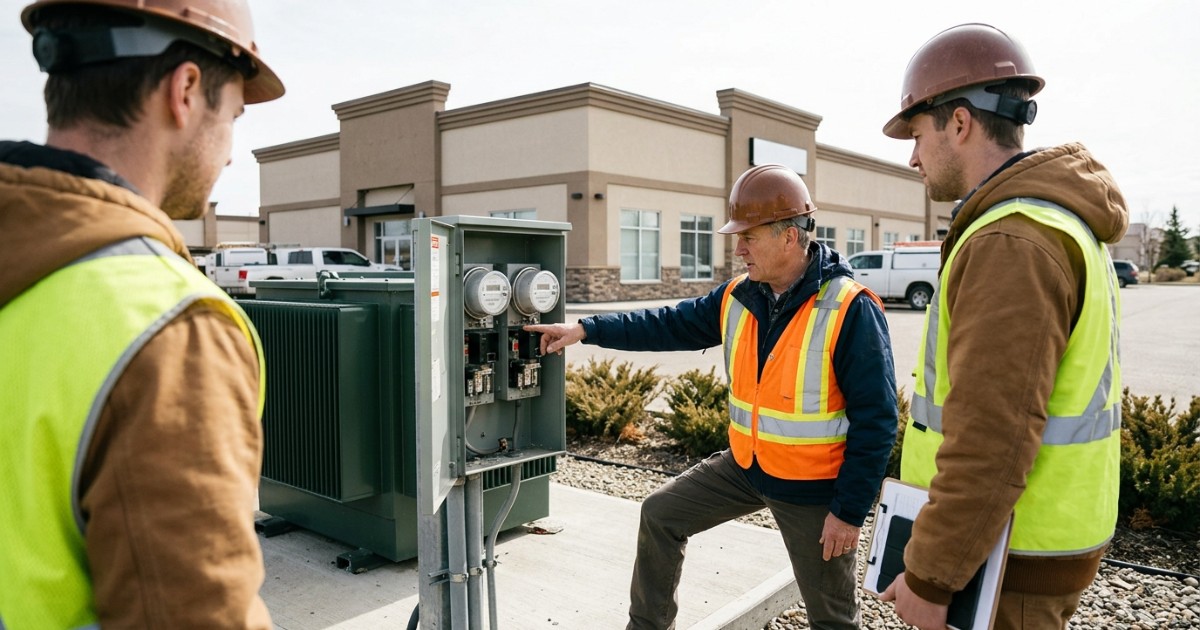
With secondary metering, the utility-owned revenue meter connects downstream of the step-down transformer. The utility provides, installs, and maintains the transformer. The customer receives low-voltage power (such as 120/208 V three-phase or 347/600 V three-phase) directly into their main service distribution panel. The meter records only the energy consumed by the customer's low-voltage switchboard. Any energy lost as heat inside the transformer core and windings is absorbed by the utility.
With primary metering, the utility installs revenue-class current transformers (CTs) and potential transformers (PTs) directly on the high-voltage feeder before it enters the facility transformer. Because the revenue meter sits ahead of the customer's transformer, the customer pays for all operational losses of that transformer. In return, Alberta electric utilities place the site on a primary service rate class, which features lower transmission and distribution tariff charges compared to standard secondary service rates.
Governing Codes and Utility Metering Guidelines
The design of both primary and secondary services is governed by the Canadian Electrical Code (CEC 2024, CSA C22.1-24) alongside utility-specific customer connection guides.
Under CEC 2024, several sections define the boundary between utility supply and customer installations:
- Section 6 (Services and Service Equipment): Governs the location, enclosure, and conductor requirements for the service point and revenue metering equipment.
- Section 26 (Installation of Electrical Equipment): Governs customer-owned transformers, dielectric fluids, containment, and clearances when a customer selects primary metering.
- Section 36 (High-Voltage Installations): Regulates installations operating at voltages exceeding 750 V. Selecting primary metering triggers the strict requirements of Section 36, including dedicated switchgear rooms, visible break isolation switches, interlock systems, and specialized grounding grids.
Electric utilities maintain binding metering guidelines that dictate hardware enclosures, instrument transformer cabinets, and communication pathways. For instance, EPCOR Customer Connection Guides define exact clearance spaces for padmount transformers and specify when an outdoor customer substation must provide utility access to revenue-metering instrument tanks. FortisAlberta sets identical demarcation rules in its commercial service requirements, which you can review in our guide on the FortisAlberta Service Application Process Explained.
How It Applies on a Real Project: Engineering Comparison
Choosing between primary and secondary metering depends on site demand, capital budget, and operational capability. Consider an industrial facility or municipal water treatment plant in Alberta requiring an installed capacity of 2,000 kVA at 347/600 V.
To evaluate conductor and switchgear ratings for this load, engineers convert kVA to current. At 600 V three-phase, a 2,000 kVA load draws approximately 1,925 A on the secondary bus. On a 13.8 kV distribution line, that same load draws roughly 84 A on the primary side. Designers can check these figures quickly using a kVA to Amps Calculator.
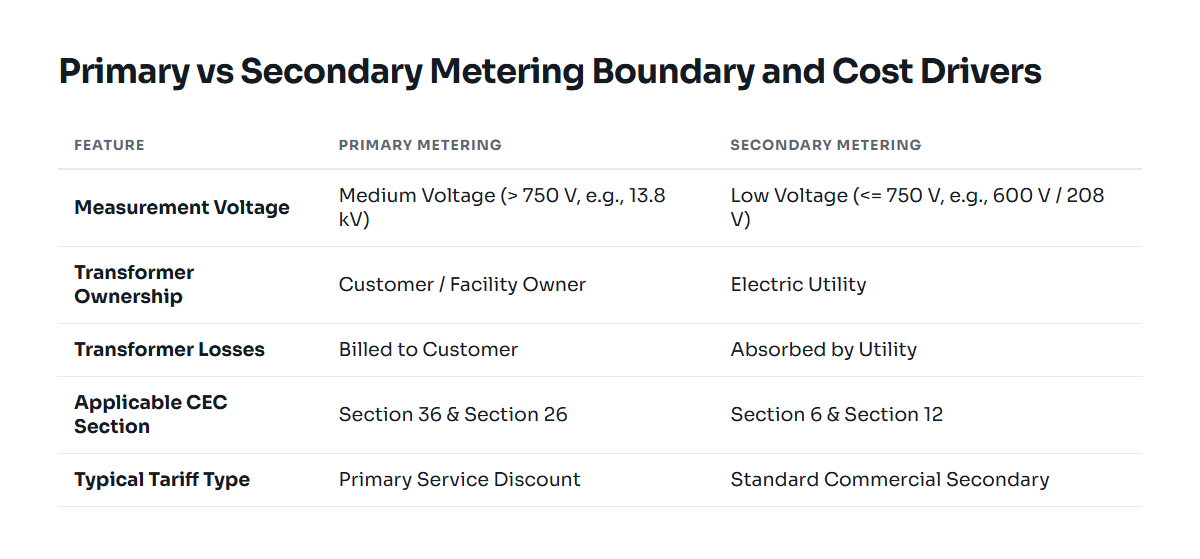
| Evaluation Metric | Secondary Metering (Utility Transformer) | Primary Metering (Customer Substation) |
|---|---|---|
| Demarcation Point | Secondary terminals of the utility transformer or customer switchboard | High-voltage disconnect switch ahead of customer transformer |
| Transformer Ownership | Electric Distribution Utility (e.g., EPCOR, FortisAlberta) | Customer / Facility Owner |
| Transformer Losses | Paid by the utility | Paid by the customer (typically 1% to 2% of total consumption) |
| Distribution Rate Class | Secondary commercial tariff (higher demand/energy fees) | Primary service tariff (discounted demand/energy fees) |
| Initial Capital Expenditure | Lower (utility supplies transformer, customer buys switchboard) | Higher (customer purchases medium-voltage gear and transformer) |
| Maintenance Burden | Utility handles oil testing, repairs, and eventual replacement | Owner must conduct annual oil analysis, relay testing, and maintenance |
| Outage Recovery | Utility replaces failed equipment under system contingency | Owner must stock spares or maintain emergency replacement contracts |
Worked Scenario: The Breakeven Assessment
Assume the 2,000 kVA facility operates continuously with an average load of 1,200 kW. A modern customer-owned oil-filled transformer operating under this load experiences approximately 1.5% in combined core and copper losses, which equals 18 kW of continuous loss. Over 8,760 hours in a year, the customer pays for roughly 157,680 kWh of lost energy that never reaches the low-voltage switchboard.
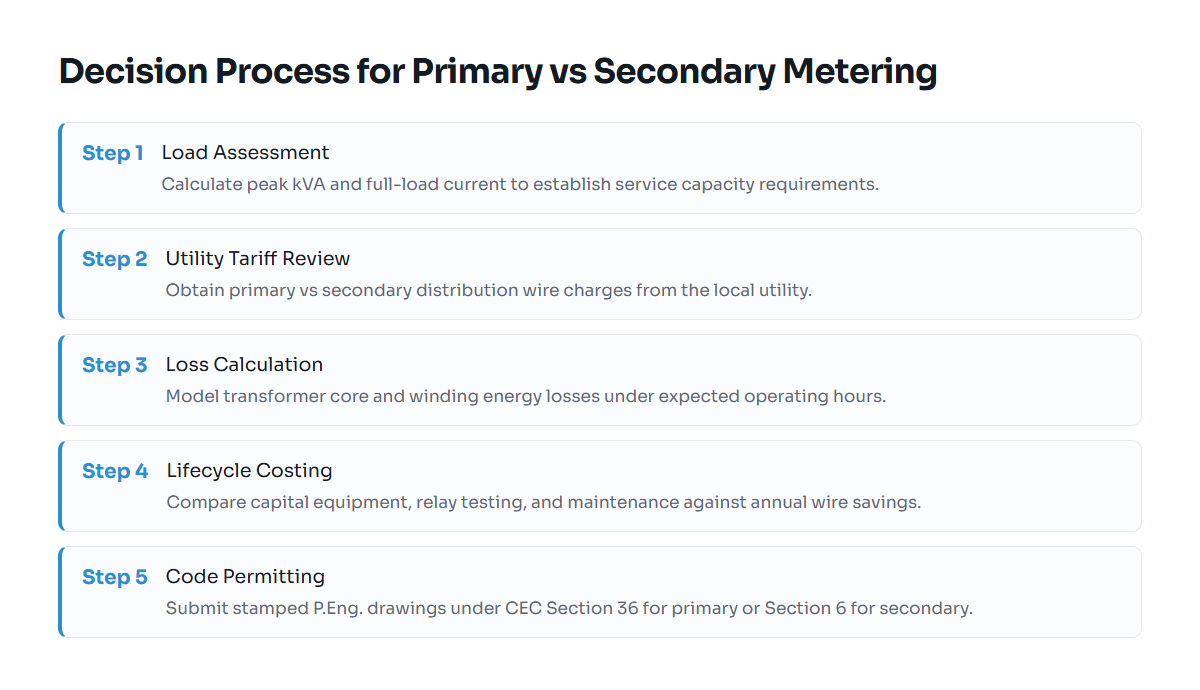
However, Alberta utilities offer primary service tariff discounts that reduce the distribution wires charges by several dollars per kilowatt of billing demand each month. If the utility tariff discount yields an annual wire-charge saving of $35,000, and the cost of the 157,680 kWh transformer loss is $18,000, the facility secures a net operating savings of $17,000 annually. The project team must then evaluate whether this $17,000 annual operational benefit justifies the higher initial capital expense of the customer-owned high-voltage substation and ongoing CSA Z463 maintenance routines.
Common Misconceptions
Several terms cause confusion across architectural and facility design teams.
Misconception 1: "Secondary Metering" Refers to Secondary Suites
In residential construction, contractors often confuse secondary metering with metering a secondary suite. A secondary suite requires private submetering or an additional utility-meter socket fed from a standard single-phase 120/240 V utility service. In engineering terms, both suite meters remain secondary metering because they operate on the low-voltage side of the utility transformer.
Misconception 2: Primary Metering is the Same as Central Metering
Central metering refers to a physical arrangement where multiple individual secondary revenue meters are grouped in a single central switchboard (such as in an apartment building or multi-bay retail strip). Central metering is almost always secondary metering. Primary metering specifies the electrical voltage level at the service entrance, not the grouping of multi-tenant meters.
Misconception 3: Primary Metering Eliminates Utility Interventions
Even though the customer owns the primary transformer, the utility still dictates the incoming high-voltage termination, fault interrupting ratings, and revenue CT/PT specifications. The installation remains subject to utility inspection before energization, regardless of ownership.
Related Technical and Regulated Market Requirements
Large municipal and energy infrastructure facilities often encounter complex metering mandates, particularly when managing multi-utility reporting for water, natural gas, and electrical power.
Dual-Utility and Multi-Commodity Metering
Directors and project managers delivering municipal pumping stations or energy assets frequently need revenue-grade dual-utility metering. In regulated Canadian markets, electrical meters must comply with Measurement Canada standards under the Electricity and Gas Inspection Act. Metering instrumentation cannot simply be tied into an unverified SCADA system for billing purposes; it must use Measurement Canada approved meters equipped with sealed pulse outputs or approved digital protocols (such as DNP3 or Modbus) to relay consumption data to both the electrical utility and plant automation systems.
Permitting, Inspection, and Engineering Requirements
Under the Alberta Safety Codes Act, installing any service entrance over 200 A or exceeding 750 V requires stamped design drawings prepared by a registered Professional Engineer (P.Eng.) licensed with APEGA. Primary metering projects fall under Section 36 of the CEC, which mandates strict coordination studies, protection relay settings, and high-voltage safety clearances. Engaging qualified electrical engineering services in Alberta early in design ensures that utility customer connection requirements, Safety Codes permits, and inspection milestones are fully met without construction delays.
For complex commercial developments, engineering teams must evaluate lifecycle costs, equipment lead times, and ongoing compliance obligations. You can explore our other engineering notes and insights to evaluate service configurations and distribution equipment selections for your next project.
Free tools: kVA to amps calculator