Installing condo EV charging electrical systems in Alberta does not require replacing the building main service in most cases. By applying an Electric Vehicle Energy Management System under Canadian Electrical Code 2024 Section 8 and Section 86, a condominium board can install multiple Level 2 chargers on existing electrical distribution by dynamically sharing available capacity rather than dedicating 100 percent nameplate power to every parking stall.
How Condo EV Charging Electrical Systems Work
Adding electric vehicle supply equipment to a multi-unit residential building requires balancing physical conduit runs, panel space, utility capacity, and billing methods. Most existing residential towers built in Edmonton and Calgary were designed with standard residential diversity. The electrical service supplies unit suites, common area lighting, elevators, and heating or cooling equipment, leaving a finite surplus before the main breaker trips.
To understand capacity, engineers first define electrical load. An electrical load is the amount of electrical power drawn by connected equipment on a circuit, measured in kilowatts or amperes. In condominium buildings, individual vehicle chargers represent continuous loads because vehicles charge for hours at a time. Under the Canadian Electrical Code, continuous loads require distinct calculations compared to intermittent residential appliances.
A condominium board typically selects one of three charging architectures:
- Individual suite-fed circuits: Branch circuits run directly from tenant subpanels to their deeded parking spaces. This option avoids complex billing but is rarely feasible beyond the first two or three suites because parkade metering rooms are physically distant and individual suite panels lack spare ampacity.
- Dedicated common-area EV distribution: A new distribution panel is tapped off the building house service or a new dedicated utility service. Power is distributed along parkade trays or busways to networked chargers.
- Managed shared distribution: Multiple charging stations connect to a common panel board overseen by an Electric Vehicle Energy Management System (EVEMS). The EVEMS actively controls charging rates, reducing current or queuing vehicles whenever overall building or feeder demand approaches operating thresholds.
The Governing Rules: CEC 2024 Section 8 and Section 86
Two primary sections of the Canadian Electrical Code (CEC 2024 Part I, CSA C22.1-24) govern condo EV infrastructure: Section 8, covering circuit loading and demand factors, and Section 86, governing electric vehicle charging systems. For detailed load formulas, consult our EV Charger Load Calculation: Canadian Code Guide.
Before adding loads, a designer must determine what parameter indicates the electrical demand on a system. The key parameter is peak apparent power measured in kilovolt-amperes (kVA), or real power in kilowatts (kW), recorded over a defined demand interval—typically 15 minutes by Alberta electric utilities such as EPCOR or ENMAX. The peak demand reflects actual coincidental usage, not the simple arithmetic sum of all connected nameplate ratings.
A demand factor in electrical calculations represents the ratio of the maximum demand of a system to the total connected load of the system. For standard equipment, CEC Section 8 permits specific demand factors based on probability of simultaneous use. Historically, vehicle chargers were counted at 100 percent of their rated capacity without diversity.
CEC 2024 Section 8 clarifies that where an EVEMS monitors and controls the electrical load, the demand calculation for the feeders and service does not need to add the full continuous rating of every connected charger. Instead, the load calculation accounts only for the maximum power permitted by the energy management controller. This provision prevents unnecessary utility transformer replacements and costly switchboard retrofits across residential multi-family properties.
Worked Example: Adding 20 Chargers to a Calgary Parkade
Consider a four-storey condominium building in Calgary with 40 units and an underground parkade. The building features an existing 800 A, 120/208 V, three-phase, four-wire service. The board wants to install 20 Level 2 chargers rated at 32 A (7.7 kW output, 40 A branch circuit overcurrent protection) for resident parking spaces.
Step 1: Determine Available Service Capacity
Total service capacity at 800 A, 120/208 V three-phase is calculated as:
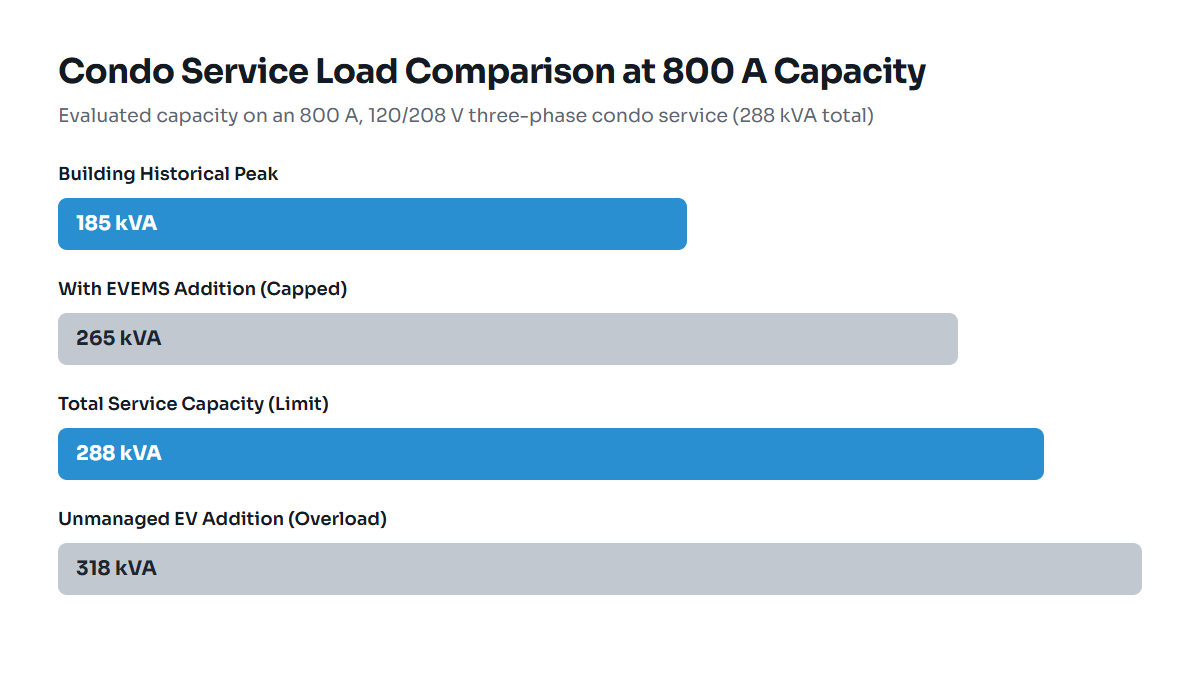
Capacity = (800 A × 208 V × 1.732) ÷ 1,000 = 288.2 kVA
An electrical load analysis reviewing 12 consecutive months of utility interval meter data from ENMAX demonstrates that the building peak recorded demand occurred during a winter cold snap at 178 kW (approximately 185 kVA at an estimated 0.96 power factor). The spare physical service capacity remaining is:
Spare Capacity = 288.2 kVA - 185 kVA = 103.2 kVA (approximately 286 A at 208 V three-phase)
Step 2: Unmanaged Installation (Without EVEMS)
If the condominium installs 20 chargers without an energy management system, each 32 A charger must be evaluated as a continuous load. At 208 V single-phase, each charger draws 32 A, translating to a connected three-phase load of:
Total Connected EV Load = (20 × 32 A × 208 V) ÷ 1,000 = 133.1 kVA
Comparing 133.1 kVA of required load against the 103.2 kVA of available capacity reveals a deficit of 29.9 kVA. Without management, this project would require an expensive utility service upgrade, transformer replacement, and main switchboard renewal.
Step 3: Managed Installation (With EVEMS)
By implementing an EVEMS, the maximum demand allowed to the EV distribution subpanel is capped by hardware and software control. The designer sets the ceiling for the EV panel at 80 kVA (222 A at 208 V three-phase), comfortably below the 103.2 kVA margin.
When all 20 vehicles plug in simultaneously, the system throttles each charger to share the 80 kVA pool, delivering roughly 11 A to 16 A per vehicle. As vehicles complete their charge cycles overnight, the remaining active vehicles automatically return to full 32 A charging speeds. The installation fully complies with CEC Section 8 and Section 86 without upgrading the 800 A service entrance.
| Metric | Unmanaged System | EVEMS-Managed System |
|---|---|---|
| Total Connected Chargers | 20 units (32 A each) | 20 units (32 A each) |
| Theoretical EV Peak Load | 133.1 kVA | 80.0 kVA (Controlled limit) |
| Building Available Margin | 103.2 kVA | 103.2 kVA |
| Service Upgrade Required? | Yes (800 A to 1,200 A) | No (Retains existing 800 A service) |
| Code Compliance Basis | CEC Section 8 continuous rating | CEC Section 8 and 86 EVEMS rules |
Common Mistakes in Condo EV Electrical Design
Condo electrical retrofits fail when critical planning steps are skipped before purchasing charging hardware:
- Relying on billing estimates instead of interval meter data: Utility bills stating monthly kilowatt-hour consumption do not show true instantaneous peak demand. An electrical load calculation for commercial or multi-family properties requires interval peak demand data (15-minute intervals) obtained through formal authorization from utilities like EPCOR or ENMAX.
- Neglecting core penetrations and firestopping: Parkade levels are separate fire compartments under the National Building Code (Alberta Edition). Running conduit through concrete floor slabs or shear walls without engineered coring scans and certified CAN/ULC-S115 through-penetration firestops creates building code violations during municipal inspection.
- Failing to account for harmonic distortion and continuous heat: EV chargers are solid-state power converters. Operating dozens of non-linear loads simultaneously creates heat in panels and neutral conductors. Panelboards must be specified with adequate ventilation, commercial bus ampacities, and neutral ratings appropriate for non-linear commercial electrical design in Alberta.
- Omitting commercial electrical permits: Multi-unit residential parkades are treated as commercial installations by Alberta inspection authorities. A commercial electrical permit is required before construction begins. Skipping permit support for electrical design often leads to stop-work orders and uninsurable property risks.
Checklist for Condo EV Charging Projects
Condominium corporations, boards, and property managers should follow this procedural checklist to execute an EV charging installation cleanly:
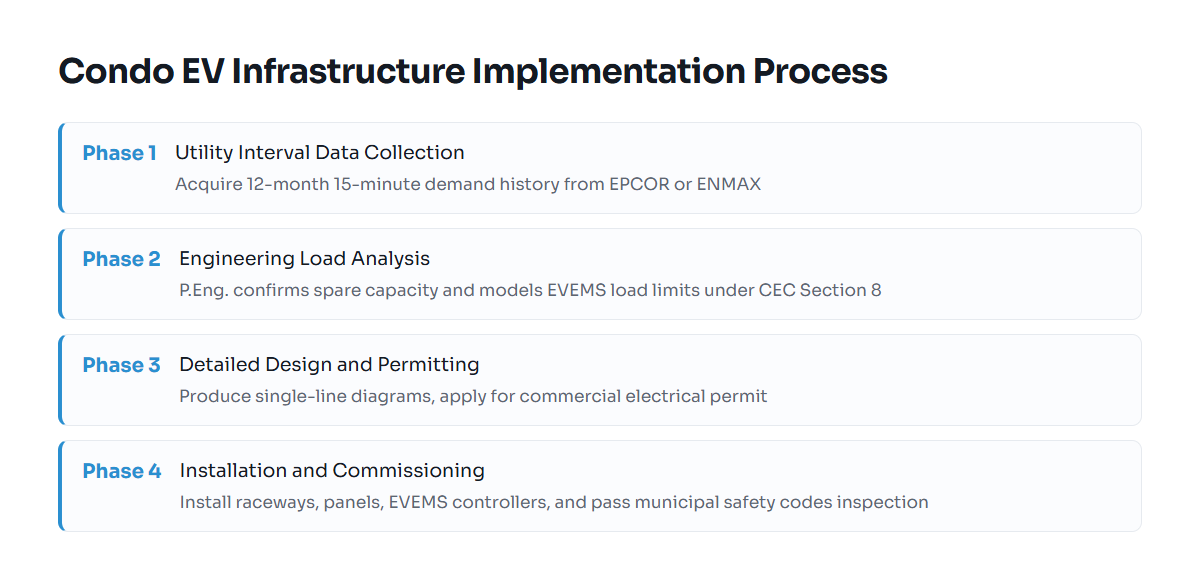
- Acquire Historical Utility Data: Request 12 to 24 months of 15-minute interval demand data from the electric distribution utility to verify actual historical peak loading.
- Engage an Engineer for Load Analysis: Retain a registered engineering firm to perform an electrical load analysis and evaluate transformer, switchgear, and feeder ratings in accordance with CEC 2024. amplify provides comprehensive electrical engineering services in Alberta for multi-family property owners.
- Select an EVEMS-Compatible Hardware Platform: Ensure the chosen charging hardware supports open protocols (such as OCPP) and features utility-grade revenue metering for fair tenant cost recovery.
- Complete Detailed Engineering Drawings: Produce single-line diagrams, parkade conduit layouts, panel schedules, and structural coring details. These drawings form the design submission for plan review.
- Apply for Commercial Electrical Permits: The licensed electrical contractor applies for the commercial electrical permit with the local authority having jurisdiction (e.g., City of Edmonton, City of Calgary, or an accredited inspection agency) using the signed and sealed engineering package.
- Install, Commission, and Inspect: After installation, commission the EVEMS control sequences, test dynamic current throttling under simulated peak loads, and pass final inspection by the safety codes officer.
Free tools: kVA to amps calculator