
An electrical permit in Alberta is a legal authorization issued under the Safety Codes Act that grants permission to install, alter, or extend electrical systems. The permit confirms that the planned work complies with the Canadian Electrical Code (CSA C22.1) and provincial regulations. In most commercial, institutional, and multi-family applications, permits must be obtained by an Alberta-certified Master Electrician representing a registered electrical contractor before work begins.
Overview of Electrical Permits in Alberta
The province of Alberta enforces technical safety through the Safety Codes Act and the Electrical Code Regulation. These statutes mandate that electrical work requires a permit unless specifically exempted by regulation. Minor maintenance tasks, such as replacing a light switch with an equivalent device or replacing a single ballast, do not require a permit. Installing new branch circuits, altering electrical services, adding transformers, or replacing distribution panels always require one.
Permits serve two legal functions. First, they notify the local Authority Having Jurisdiction (AHJ) that regulated work is taking place. Second, they initiate the formal inspection lifecycle, establishing inspection checkpoints that confirm code compliance prior to concealment and energization.
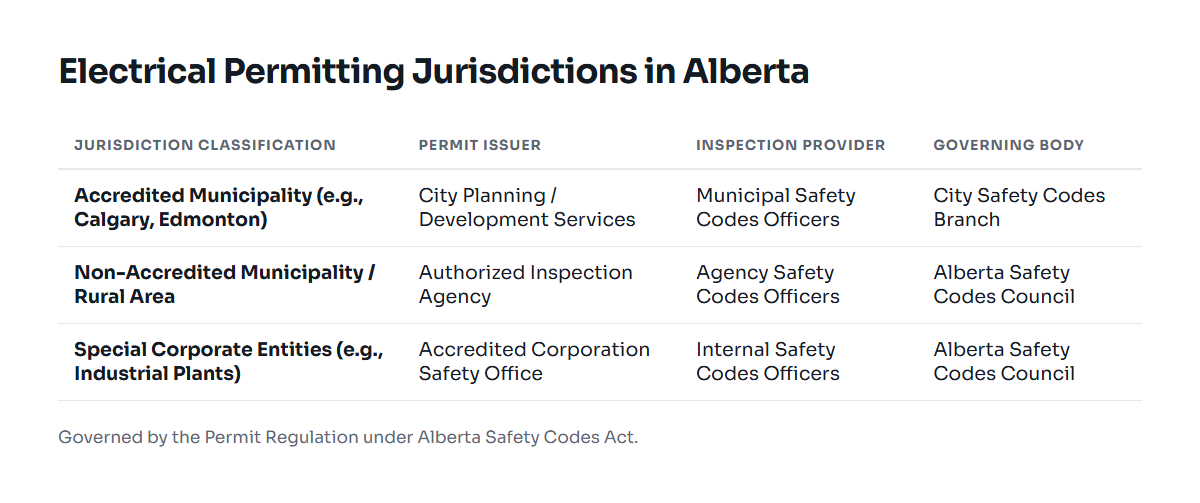
Permit administration across Alberta depends on local municipal status:
- Accredited Municipalities: Cities such as Calgary, Edmonton, Red Deer, Lethbridge, and Medicine Hat manage their own safety codes permitting branches. They review plans, issue electrical permits, collect fees, and conduct inspections using their own safety codes officers (SCOs).
- Non-Accredited Municipalities: In areas where the local municipality has not assumed safety codes accreditation, the permit is administered through an authorized inspection agency (such as Superior Safety Codes, Park Enterprises, or IJD Inspections) under the oversight of the Safety Codes Council.
For detailed drawing requirements before submission, review our guide to Electrical Permit Drawings: Alberta Requirements and Review.
Alberta Safety Codes and Engineering Standards
Two primary code standards govern electrical installations within the province: the Canadian Electrical Code Part I (CSA C22.1-24), formally adopted as the electrical standard in Alberta, and the National Building Code (2023 Alberta Edition). The Building Code establishes the baseline requirements for fire separations, emergency power distribution, exit signs, and fire alarm integration, while the CEC dictates conductor ampacities, overcurrent protection, grounding, bonding, and wiring methods.
Section 8 of the Canadian Electrical Code sets the calculation parameters for service and feeder sizing. The code distinguishes between connected load and calculated demand load:
- Connected Load: The sum of the continuous and non-continuous ratings of all equipment and devices connected to the electrical system.
- Demand Factor: The ratio of the maximum demand of a system, or part of a system, to the total connected load. Electrical loads rarely operate simultaneously at maximum capacity. CEC Section 8 permits the application of demand factors to specific occupancies and equipment categories to avoid oversized services.
- Calculated Demand: The parameter that dictates the minimum required ampacity of incoming service conductors and switchgear. Calculating this demand accurately prevents nuisance tripping without incurring unnecessary utility infrastructure expenses.
The Association of Professional Engineers and Geoscientists of Alberta (APEGA) establishes practice standards governing when drawings must be sealed by a Professional Engineer (P.Eng.). In commercial, industrial, and institutional occupancies, municipalities require engineered and sealed drawings when services exceed defined thresholds (often 200 A or 400 A depending on the AHJ), for systems exceeding 600 V, or for life safety installations such as fire alarm verification and emergency lighting systems. Our team provides comprehensive electrical engineering services in Alberta to support contractors and developers through this review process.
Commercial Electrical Permit Workflow and Calculation Example
To understand how an electrical permit moves from design to completion, consider a typical commercial tenant fit-out in an accredited Alberta municipality.
Step 1: Engineering Load Analysis
A contractor prepares to renovate a 300-square-metre commercial retail unit in a strip mall fed by a 120/208 V, 3-phase, 4-wire utility service. Before submitting the permit application, the engineer or contractor must determine the required feeder ampacity using the load calculation rules of CEC Section 8.
The unit inventory consists of:
- Basic lighting and general receptacles calculated over 300 m²: 15,000 W (based on unit area allocation)
- Rooftop HVAC unit (RTU) with compressor, indoor fan, and controls: 12,000 W
- Electric water heater: 3,000 W
- Signage and display window circuits: 2,400 W
- Refrigerated beverage coolers: 3,600 W
Total connected load equals 36,000 W. Applying Section 8 demand factors:
- General lighting and receptacles: 15,000 W at 100% continuous allocation = 15,000 W
- HVAC load: 12,000 W at 100% = 12,000 W
- Water heating: 3,000 W at 100% = 3,000 W
- Signage and display: 2,400 W at 100% = 2,400 W
- Specialty refrigeration: 3,600 W at 100% = 3,600 W
Because these commercial loads operate during normal store operating hours, minimal diversity applies. The total calculated demand is 36,000 W (36 kW).
We calculate the three-phase line current using the formula:
Line Current (I) = Demand (W) / (1.732 × Line-to-Line Voltage)
I = 36,000 W / (1.732 × 208 V) = 36,000 / 360.26 = 99.93 A
A 100 A, 120/208 V, 3-phase distribution panel matches the calculated demand. If continuous loads exceed 80% of the breaker rating, standard branch protection rules require a 125 A panel with conductors sized accordingly to maintain allowable temperature limits. You can evaluate feeder sizing and voltage limits directly using our voltage drop and SCCR calculator.
Step 2: Plan Review and Permit Issuance
The contractor submits the single-line diagram, panel schedule, and floor layout to the local municipality. The safety codes officer checks the plans against CEC Section 8 calculations, fault current ratings, and disconnect locations. Once approved, the permit is issued. Permit costs are determined by the municipality or authorized agency based on project valuation or square footage; see our detailed breakdown of Electrical Permit Cost in Alberta: $150 to $5,000+.
| Permit Type | Applicant Eligibility | Engineering Seal Required? | Typical Review Timeline |
|---|---|---|---|
| Residential Homeowner | Property owner (single-family, must reside there) | No | 1 to 3 business days |
| Commercial Tenant Improvement | Master Electrician under licensed contractor | Often required (AHJ discretion / >200 A) | 5 to 15 business days |
| New Commercial / Institutional | Master Electrician under licensed contractor | Yes (APEGA standard / building classification) | 10 to 20 business days |
| Annual Maintenance Permit | Certified plant electrician or designated contractor | No (for maintenance and like-for-like repairs) | 5 business days |
Common Misconceptions
Misunderstandings regarding the Safety Codes Act frequently cause project delays, fines, or uninspected work. Four common errors stand out in commercial construction:
- A Building Permit Covers the Electrical Work: A building permit and an electrical permit are distinct legal instruments. While building permits approve architectural and structural design under the National Building Code (Alberta Edition), they do not authorize electrical rough-in or distribution work. Contractors must secure separate permits for electrical, plumbing, gas, and mechanical scopes.
- Any Journeyperson Electrician Can Pull a Commercial Permit: In Alberta, holding a Journeyperson Electrician certificate of qualification is not sufficient to pull a permit. Commercial electrical permits must be applied for by a certified Master Electrician who is employed by or associated with a licensed electrical contractor registered with the Alberta Safety Codes Council or the local accredited municipality.
- Plans Are Only Required for High-Voltage Projects: Many contractors assume that drawings are only requested for services over 600 V. In practice, accredited municipalities such as Calgary and Edmonton routinely require engineered plan submissions for commercial services over 200 A, for any change of building occupancy, and for specialized systems like life safety alarms or hazardous locations. Refer to our Electrical Drawing Checklist for Alberta Permits to prepare submittals properly.
- Inspectors Act as Field Designers: A Safety Codes Officer verifies whether installed systems comply with the code. They do not calculate feeder sizes, perform short-circuit calculations, or resolve spatial coordination errors on site. Deficiencies identified during inspections stall projects until the contractor submits corrective documentation.
Related Requirements and Inspection Lifecycle
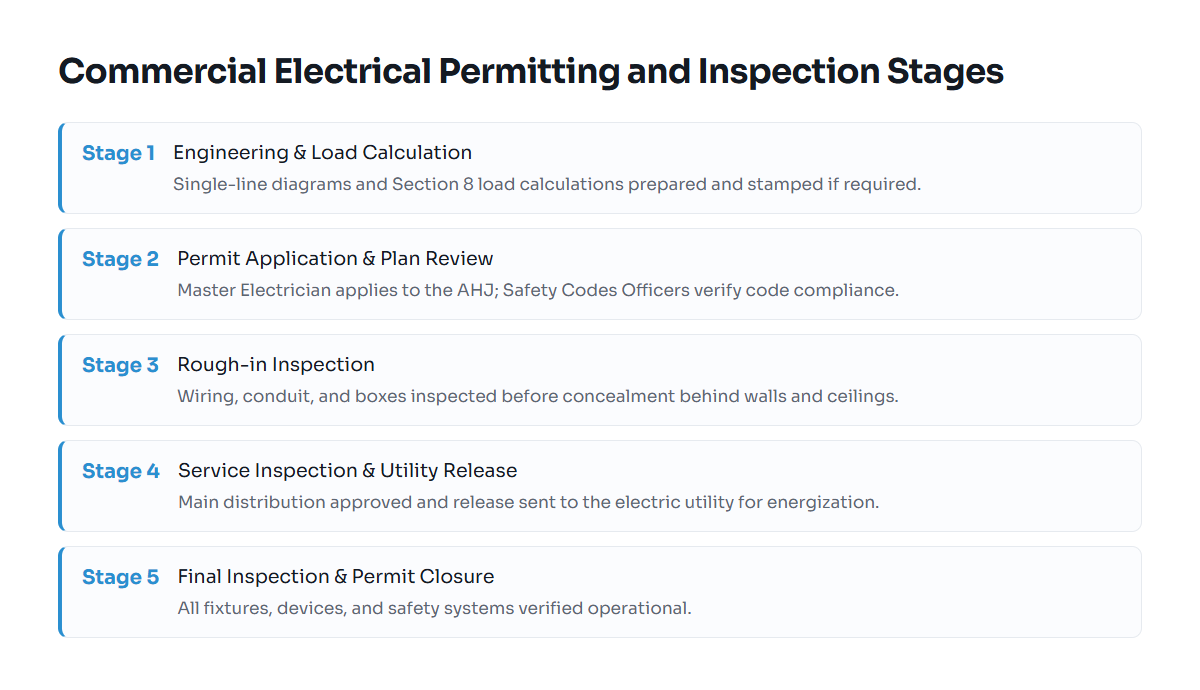
Securing the permit document is only the start of the compliance process. To achieve a final permit closure, the installation must progress through sequential field inspections:
- Rough-in Inspection: Performed after raceways, cables, junction boxes, and panel enclosures are installed, but before walls, ceilings, and insulation conceal the wiring. The inspector checks conductor sizing, box fill, firestop penetrations, and cable support.
- Service / Utility Inspection: Required when establishing a new electrical service or upgrading existing main distribution equipment. The safety codes officer checks the service head, meter base, main disconnect, and system grounding. Once passed, the AHJ issues a formal electrical release to the local distribution utility (such as ENMAX in Calgary, EPCOR in Edmonton, or FortisAlberta in rural areas) authorizing connection to the grid.
- Final Inspection: Conducted when all devices, fixtures, faceplates, cover plates, and utilization equipment are installed, connected, and operational. The inspector verifies panel directories, breaker ratings, ground-fault circuit interrupter operation, and emergency exit lighting illumination.
Every permit issued in Alberta also incurs the Safety Codes Council levy, a mandatory provincial fee added to all safety codes permits to fund oversight and code enforcement administration. For more engineering analysis and design practice updates, browse our technical library of engineering notes and insights.
Free tools: kVA to amps calculator